Photojournalism: History and Practice (1850-1960s)
This page is created as a resource for students studying Photojournalism History and Practice using open sources.
Content in continuous development.
Roger Fenton - The Crimean War
(1)
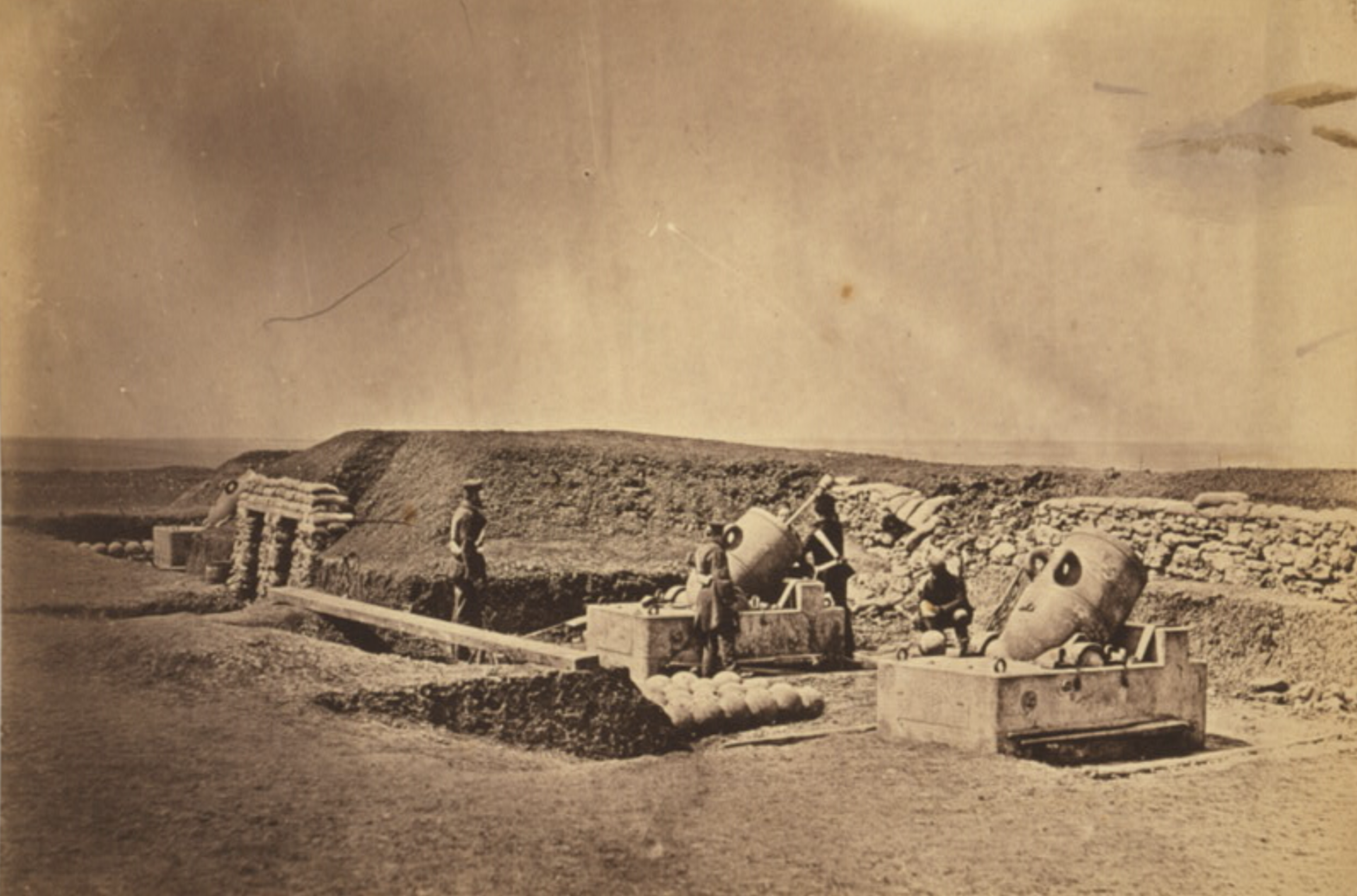
The Crimean War. 1855. Roger Fenton.
Roger Fenton is often cited as one of the first photographers to take a camera into the field to cover war.
He produced a relatively small catalogue of photos depicting the Crimean War, which took place between 1853 and 1856. His work was captured during four months of the war in 1855. Today the future of Crimea is one of the issues at stake in the current war between Russia and Ukraine.
Fenton aspired to be a painter, but at some point decided his talent was not sufficient to make a living as an artist. It is believed he may have been introduced to photography as a means of assisting the process of painting. A British publishing house hired Fenton to sail to Crimea to photograph the war. The details of this arrangement are available in the source material linked below.
In addition to his early, very bulky camera, Fenton converted a carriage into a mobile darkroom that would allow him to develop his images in the field. Because cameras of the day were so large, and the process of making a photograph required long exposures, Fenton was not able to photograph combat scenes, or even scenes that occurred right after a battle. Nevertheless, Fenton’s work is considered to be among the first attempts to use photography to document war.
Background on Roger Fenton and the Crimean War - The U.S. Library of Congress(Includes images)
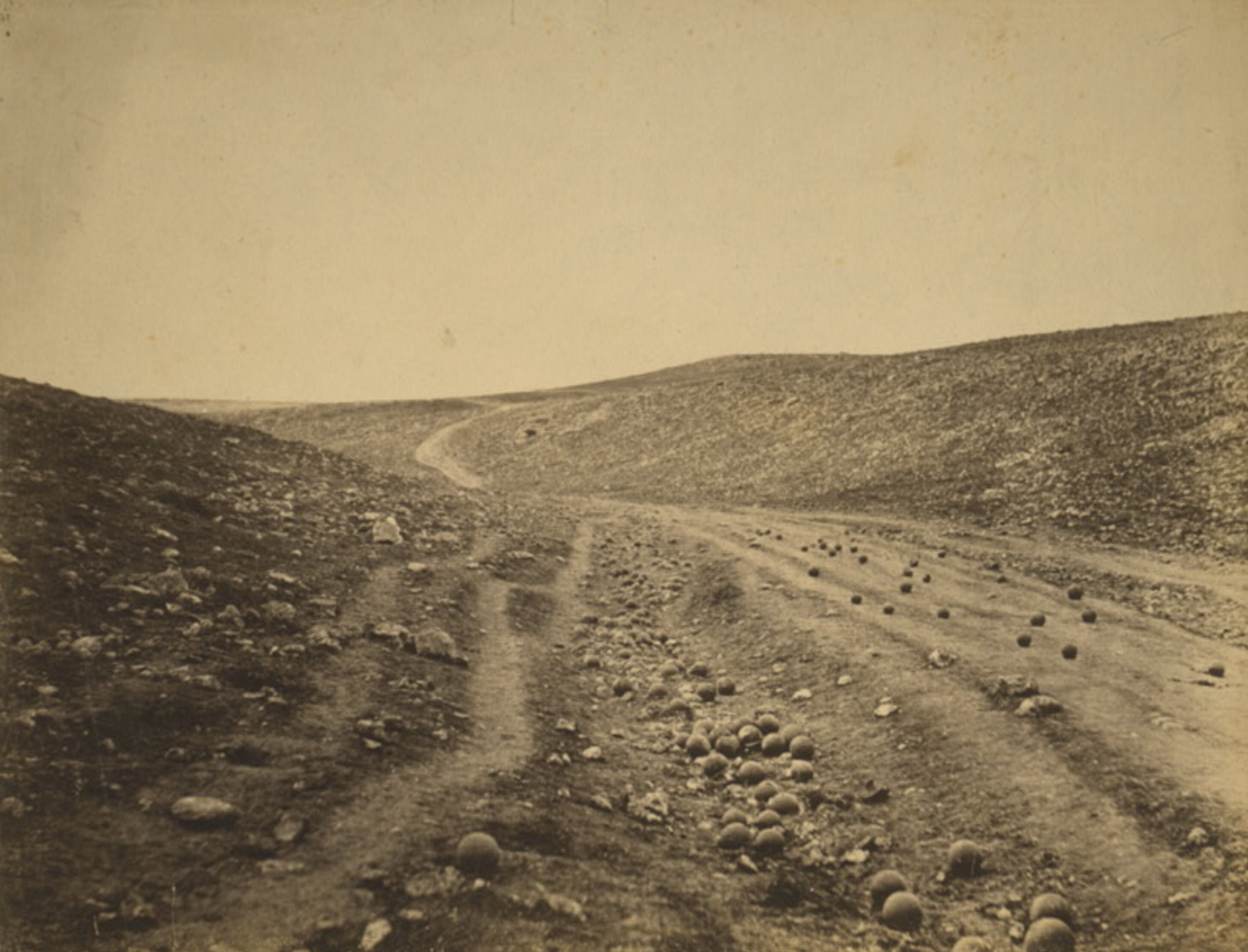
The Valley of the Shadow of Death. 1855. Roger Fenton.
This photo, known as the Valley of the Shadow of Death, was taken after a battle during the Crimean War. The existence of a similar photo, with fewer cannonballs on the road itself, has led some to question whether Fenton manipulated this photo by moving cannonballs on or off the road. Film maker Errol Morris produced an entire film and book on the controversy.
Whether Fenton manipulated the photo or not, the controversy illustrates the push and pull over the ethics of photojournalism.
Are photojournalists responsible only to simply record the world as they see it, or are they allowed to use the tools or approach of an artist in service of showing a larger truth?
Is a camera simply a tool used to record reality, or is it a tool used to turn reality into art?
Mathew Brady - American Civil War
(2)
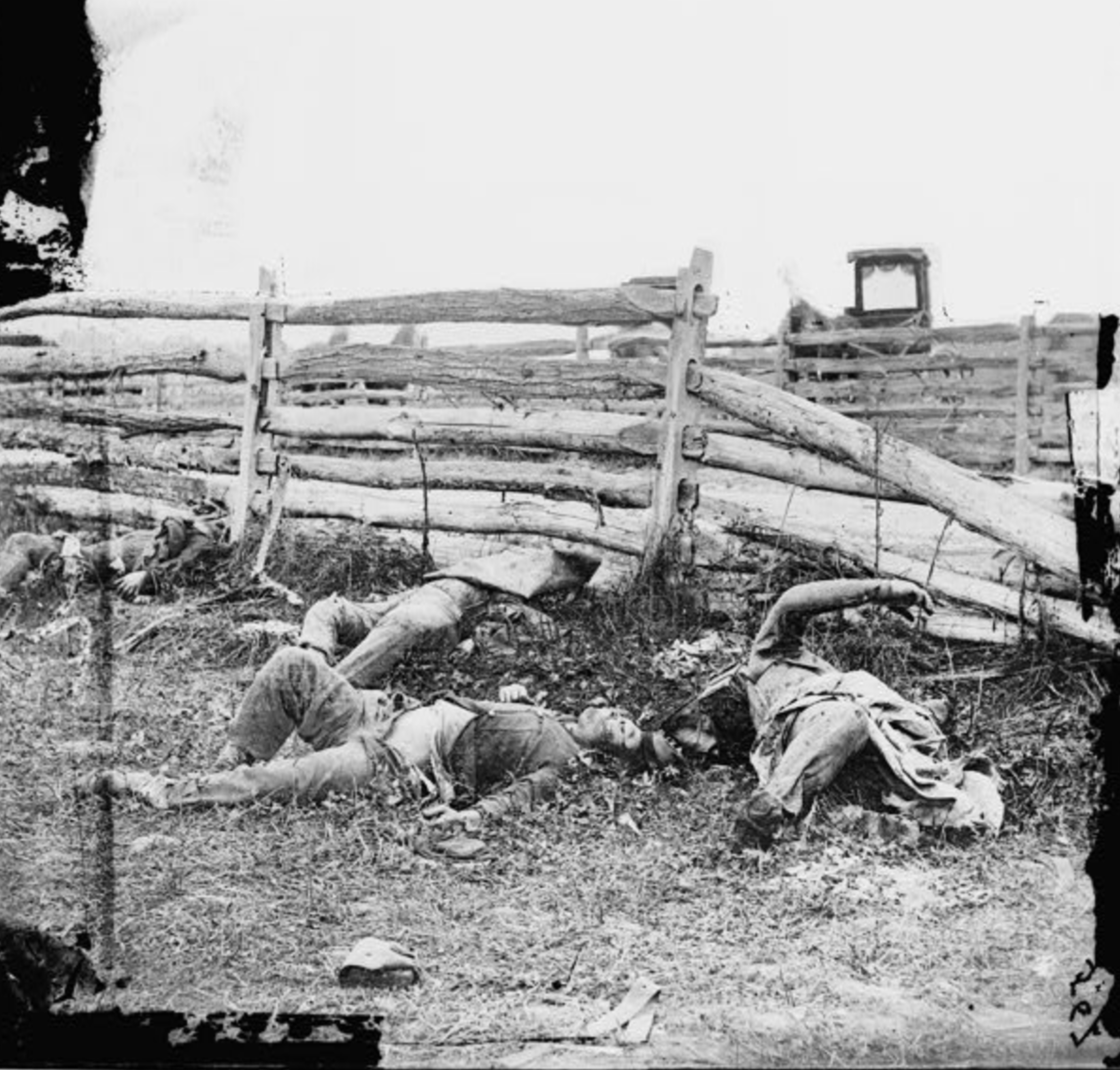
War dead. Battle of Antietam. 1862
American Civil War. Photographer: Alexander Gardner
Mathew Brady was an accomplished portrait photographer in the mid-1800s in New York City and Washington, D.C.
When the U.S. Civil War began he decided to put together a group of photographers to record the war by bringing cameras onto the battlefield. As the organizer of the effort, the resulting photos are often credited to him: Brady Photograph or Photograph by Brady. He however did not take most of the photos. Brady had up to twenty photographers in the field and he also purchased photos made by others who were independently taking pictures of events in different parts of the country.
The photo at the start of this entry was taken by Alexander Gardner, a Brady associate. It is considered one of the most important photographs of the war, because when it was published, it was the first time the American public could witness - through photography - the horrors of battle.
Mathew Brady - U.S. Library of Congress
Alexander Gardner - American Battefield Trust
Gardner is credited with taking the last photo portrait of former President Abraham Lincoln. There is disagreement over when the photo was taken. Either in February of the year he died, or just a few days before the assassination.
A crack in the original negative is responsible for the line going across the top of the photograph and through Lincoln’s head. Following the assassination, some saw the cracked negative as an omen of what was to come.
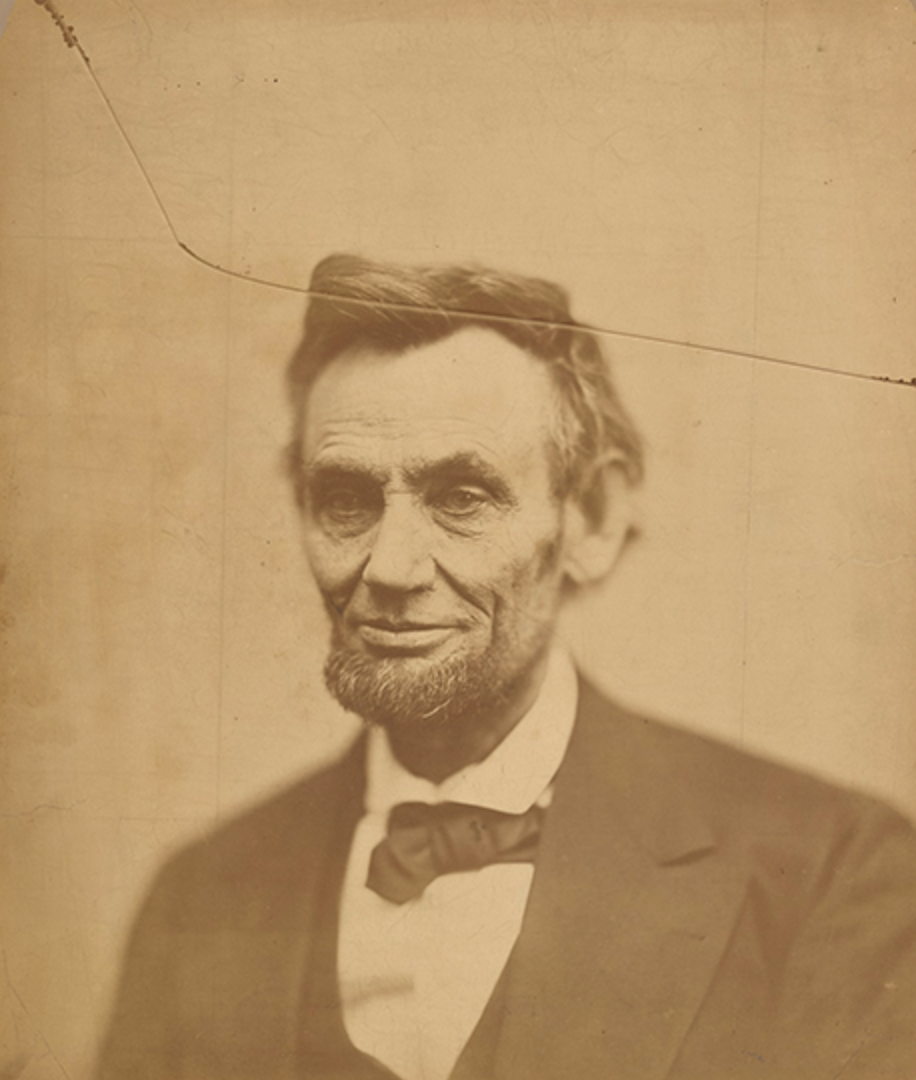
Photographer: Alexander Gardner
Mathew Brady’s role in organizing a group of photographers to document an on-going war is considered a breakthrough in photojournalism and created a template for the future of use of photography in the coverage of war.
Lincoln Portrait - National Portrait Gallery
Derivative work
Sally Mann
(3)
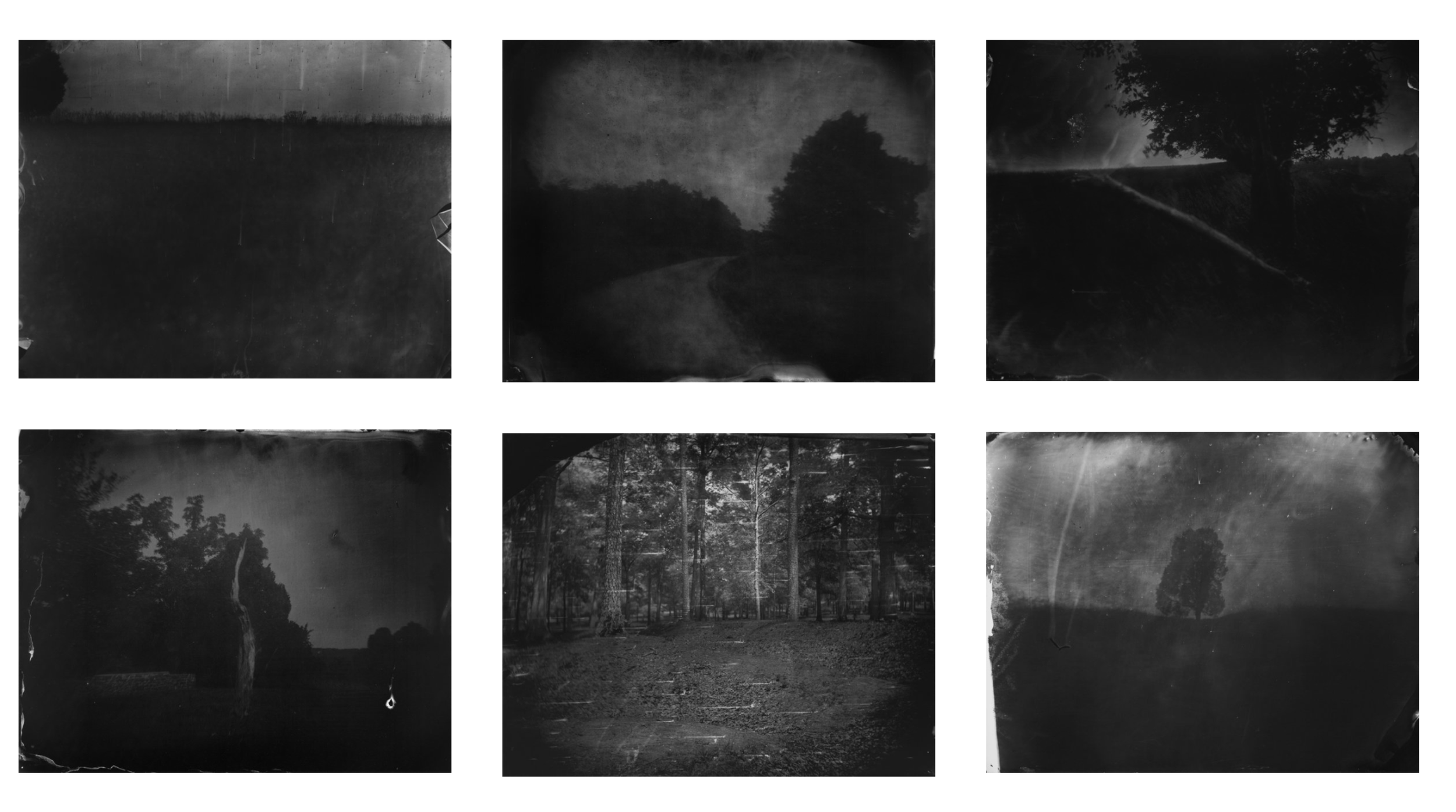
Photos: Sally Mann. (sallymann.com)
Sally Mann is a contemporary photographer who often uses glass plate negatives to make images of her subjects.
In her work, the imperfection of the prints and the open acknowledgement of interaction between glass, chemicals, and light is all part of the story she is attempting to tell.
One of Mann’s many acclaimed projects is titled: Battlefields. She visited several Civil War battlefields and photographed them as they are today using the photographic techniques of the Civil War era. The result is a series of dreamlike photos that invite the viewer to travel back in time, or to feel the ghosts of the men who fought on these grounds more than 100 years ago.
Q: Is Sally Mann’s work photojournalism, art, or something else?
Robert Capa
(1913-1954)
(4)
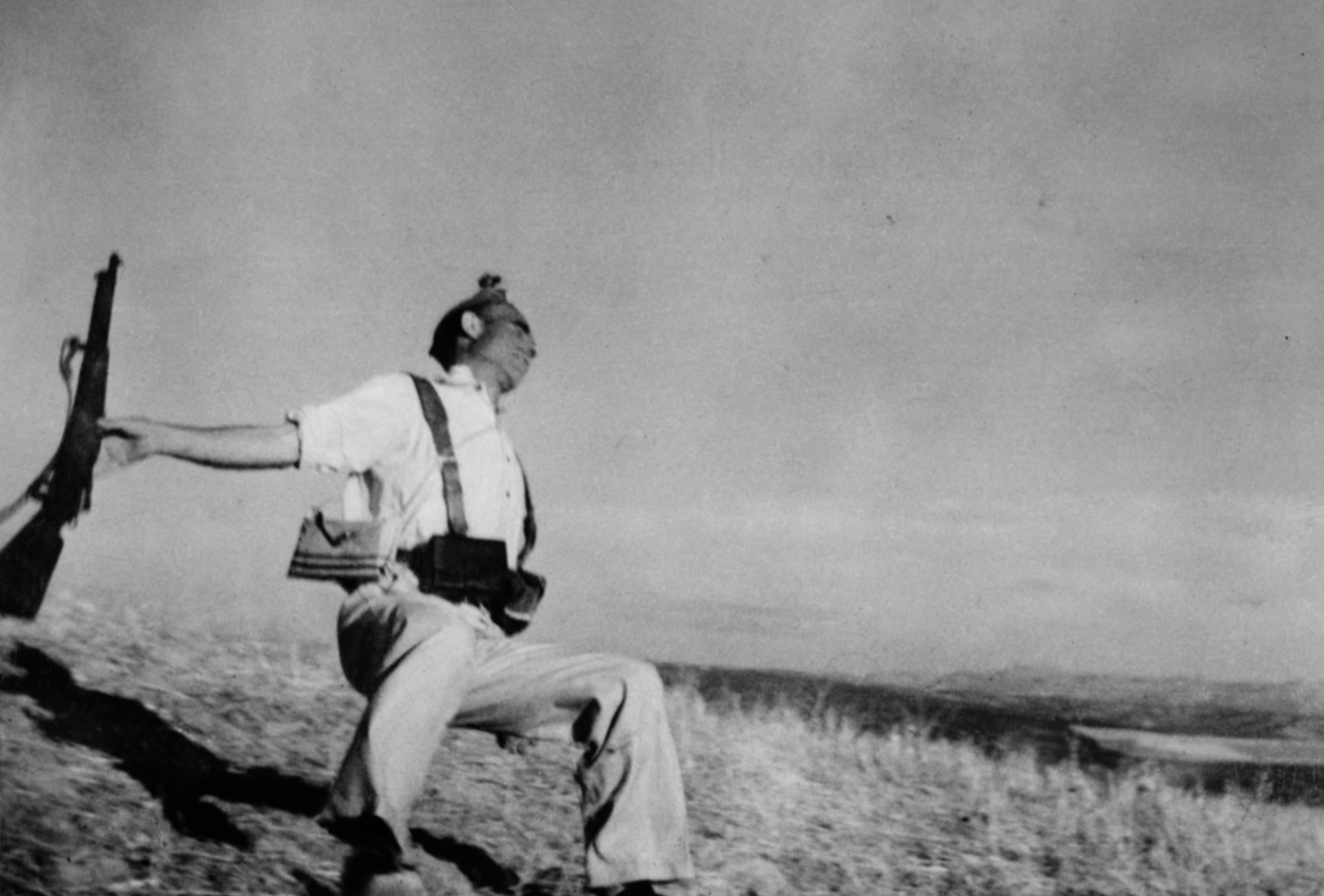
Death of a loyalist soldier. Spain. 1936 (Magnum Photos).
Robert Capa is perhaps the best known war photographer of the first half of the 20th century. He began his career in Paris in the 1930s, worked alongside many successful photographers of the era, made a name for himself covering the Spanish Civil War and went on to cover World War II. He was a founding member of Magnum, a cooperative photo agency that supplied photos to publications around the world. He was killed when he stepped on a land mine while covering the French war in Vietnam in 1954.
His most famous photo is the one at the top of this post showing the death of a loyalist soldier during the Spanish Civil War. The photo has been the subject of debate for decades, not because of its gruesome nature, but because some critics believe the photo was staged. There has been no evidence offered of this claim and Capa himself acknowledged the chance involved in taking a photo at this precise moment, but he stood by the authenticity of the picture.
There is no doubt that Capa inspired many who followed him in the field of photojournalism. Many of his World War II photos would serve as inspiration to American photographers who began their careers covering the Vietnam War in the 1960s and 1970s. Those Vietnam era photographers then inspired many of the photojournalists covering conflicts today.
Capa’s brother Cornell went on to found the International Center for Photography in New York City in his brother’s memory.
Robert Capa Profile - International Center for Photography
Capa Selected Works - Magnum Photos
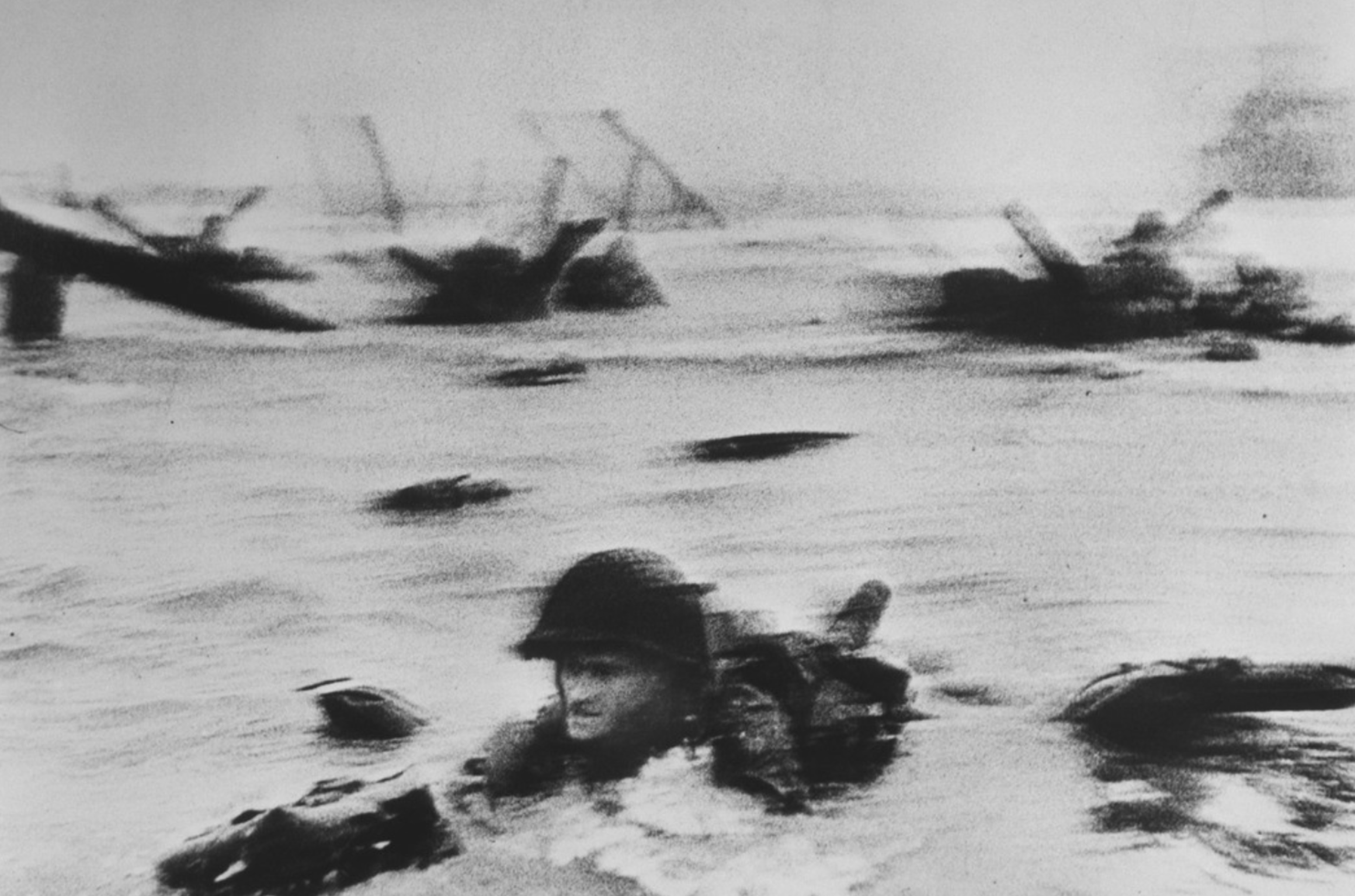
Omaha Beach, D-Day. 1944 (Magnum Photos).
Capa’s photograph of U.S. troops advancing on the beaches of Normandy, France on D-Day in World War II demonstrates his belief in getting as close to the action as possible. He was quoted as saying “if your photographs aren’t good enough you are not close enough.” His use of a hand held 35mm camera - which is still the standard today - allowed him and photographers of his era to get close and not waste time with camera set up.
This has become an iconic photo of World War II, but if Capa had a choice it is possible it would have never been published. His film was damaged in transit from the front lines to his photo editor and this blurry image was one of only a few that were considered worthy of publication. The motion blur in the photo makes it more effective and communicates the chaos of war and the desperation of a soldier in battle.
David Seymour
1911 - 1956
(5)
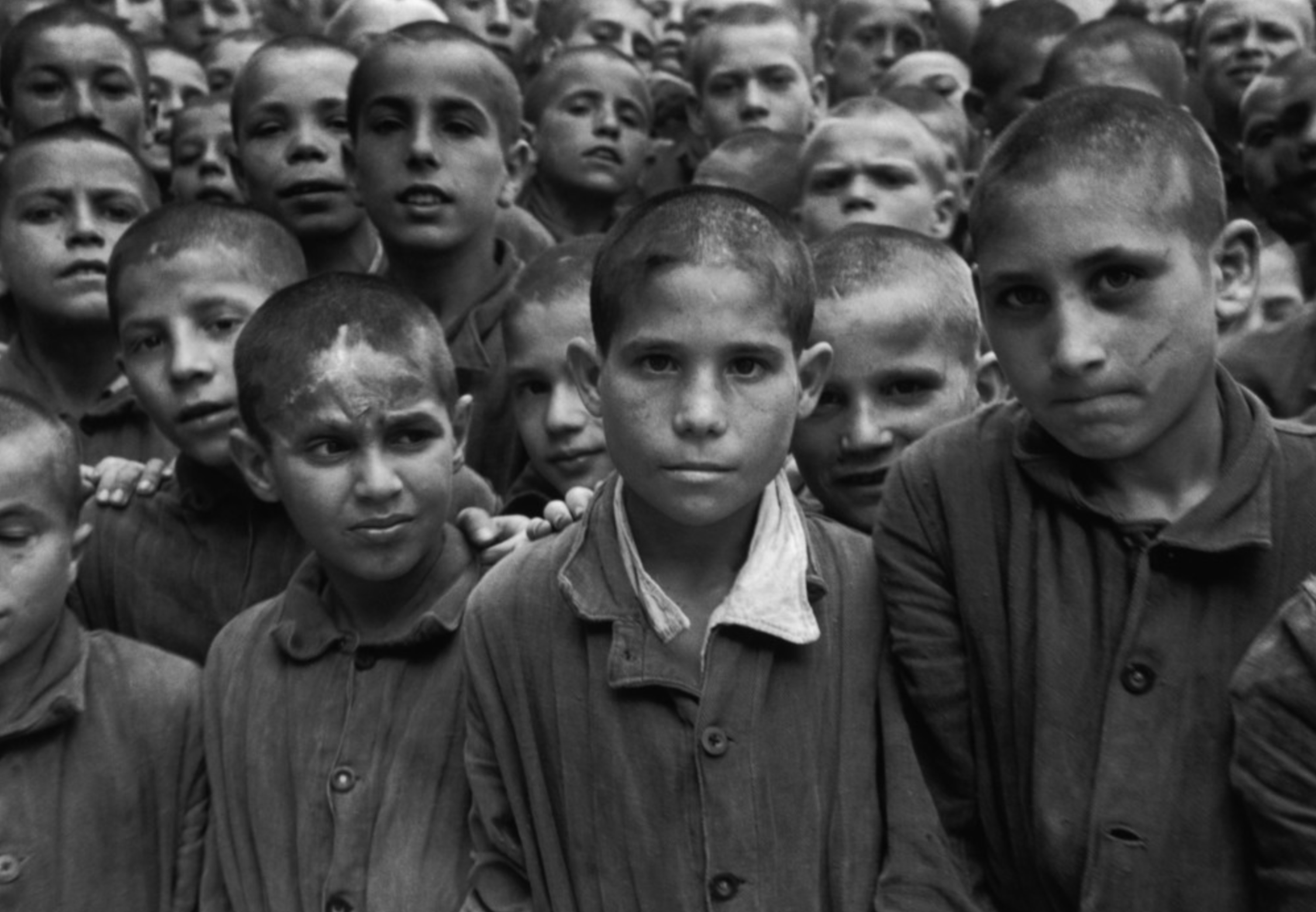
From the Series Children of Europe, 1948. Naples, Italy (Magnum).
Along with Robert Capa, Henri Cartier-Bresson and others, David Seymour was a co-founder of Magnum Photos and ran the co-operative for twenty years after Capa’s death. Known as “Chim”(pronounced Shim), began working as a freelance photographer for European magazines in around 1933. Like others of his era, he photographed the Spanish Civil War, World War II, and the aftermath of WW II.
In his work you can see a technique that he borrows from portraiture, asking his subjects to look directly into the lens of the camera. This is not the technique used in most candid photography, war photography, or even street photography, but it is very effective and does nothing to diminish the story-telling aspect of the photo. Because we are making eye contact with the subject, the technique humanizes the person being photographed. It is harder to look away, it is easier to feel empathy.
Later in his career Seymour did more formal portraiture work of political leaders and entertainment figures.
He died in 1956 while working on a story about a prisoner exchange near the Suez Canal. He was hit by Egyptian machine gun fire.
David “Chim” Seymour - Biography and Work - Magnum Photos
Margaret Bourke-White
1904-1971
(6)
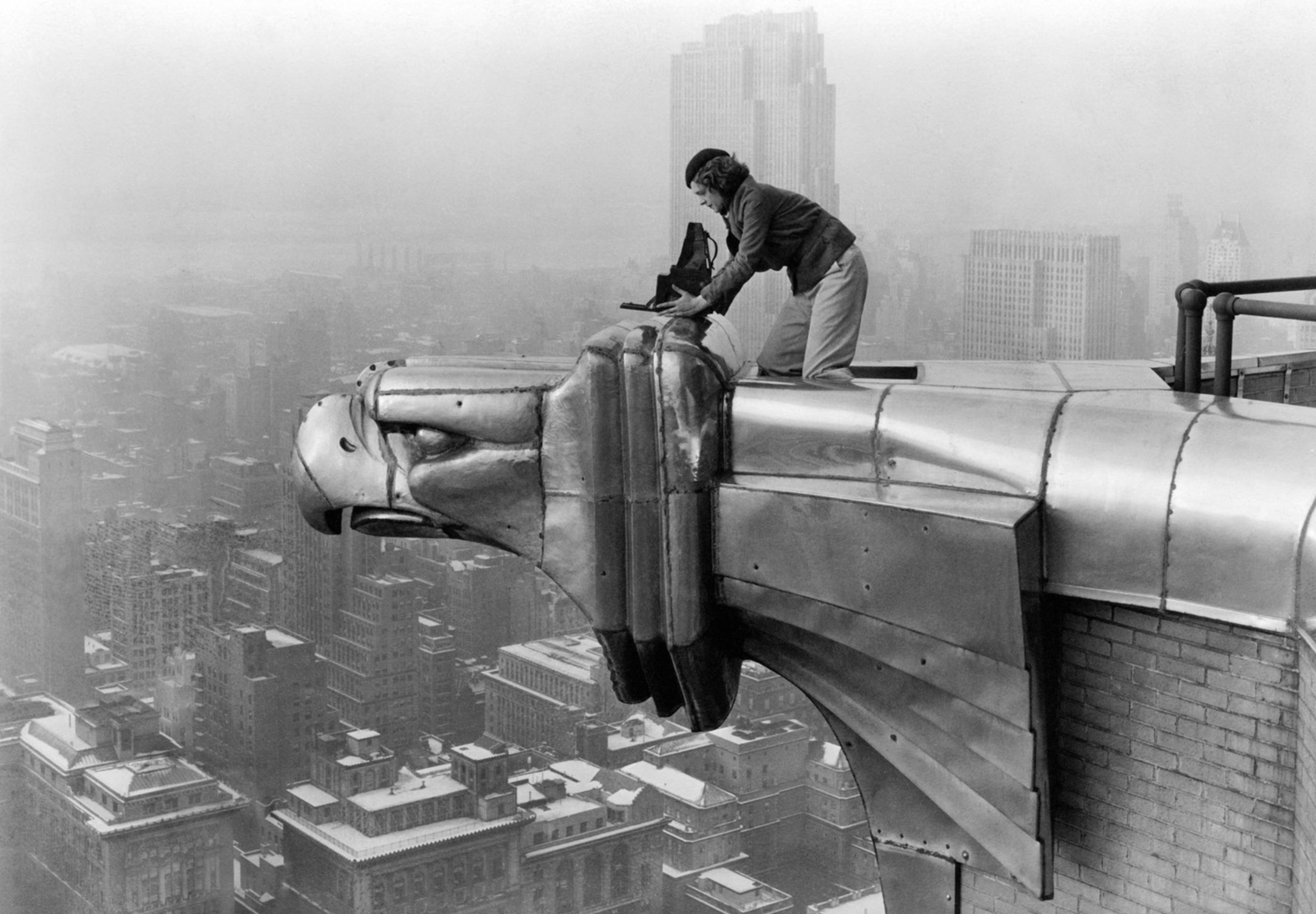
Oscar Graubner Image. LIFE Images collection via Getty. New York City, 1934.
Bourke-White on top of the Chrysler Building.
Margaret Bourke-White became interested in photography after taking a course at a photography school while she was attending Columbia University.
She graduated a few years later from Cornell University with a degree in biology, but was hooked on photography and soon opened her own studio in Cleveland. Most of her early work was centered around industrial photography. That work caught the attention of Henry Luce, the founder of TIME Magazine, Fortune, and later LIFE magazine. She was the first photographer hired for Fortune in 1929. Between 1929 and 1957 she was a leading photographer of her time, traveling internationally, covering World War II, and completing a number of long term projects in parts of the world inaccessible to most. The projects include:
First photographer hired for LIFE magazine
World War II and Europe
The German invasion of Moscow
Traveled with General George Patton through Germany
The liberation of German concentration camps
Ghandi and the fight for independence in India
Unrest in South Africa
The Korean War
In the final decades of her life, Bourke-White lived in Connecticut. First in Darien and later in Stamford. She was diagnosed with Parkinson’s Disease in 1953 and her last major work was published in 1957. She died in Stamford Hospital in 1971.
Resources:
Margaret Bourke-White -Biography - International Center for Photography
Biography and Images - Museum of Modern Art
The Photography of Margaret Bourke-White - The Atlantic(subscription may be required)
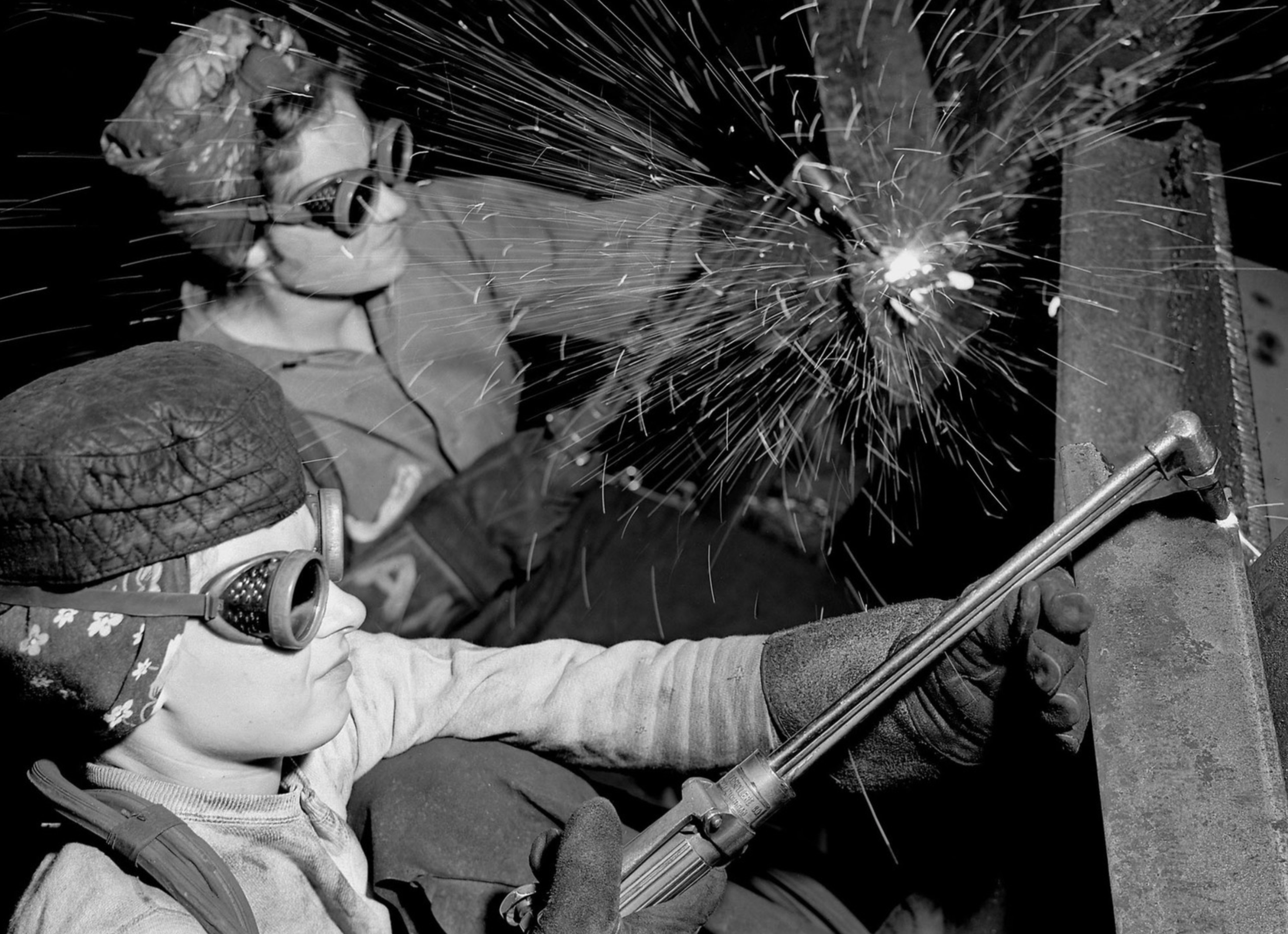
Women workers replace men in an Indiana factory during World War II. 1942.
Bourke-White LIFE collection via Getty.
Dorothea Lange
1895 - 1965
(7)
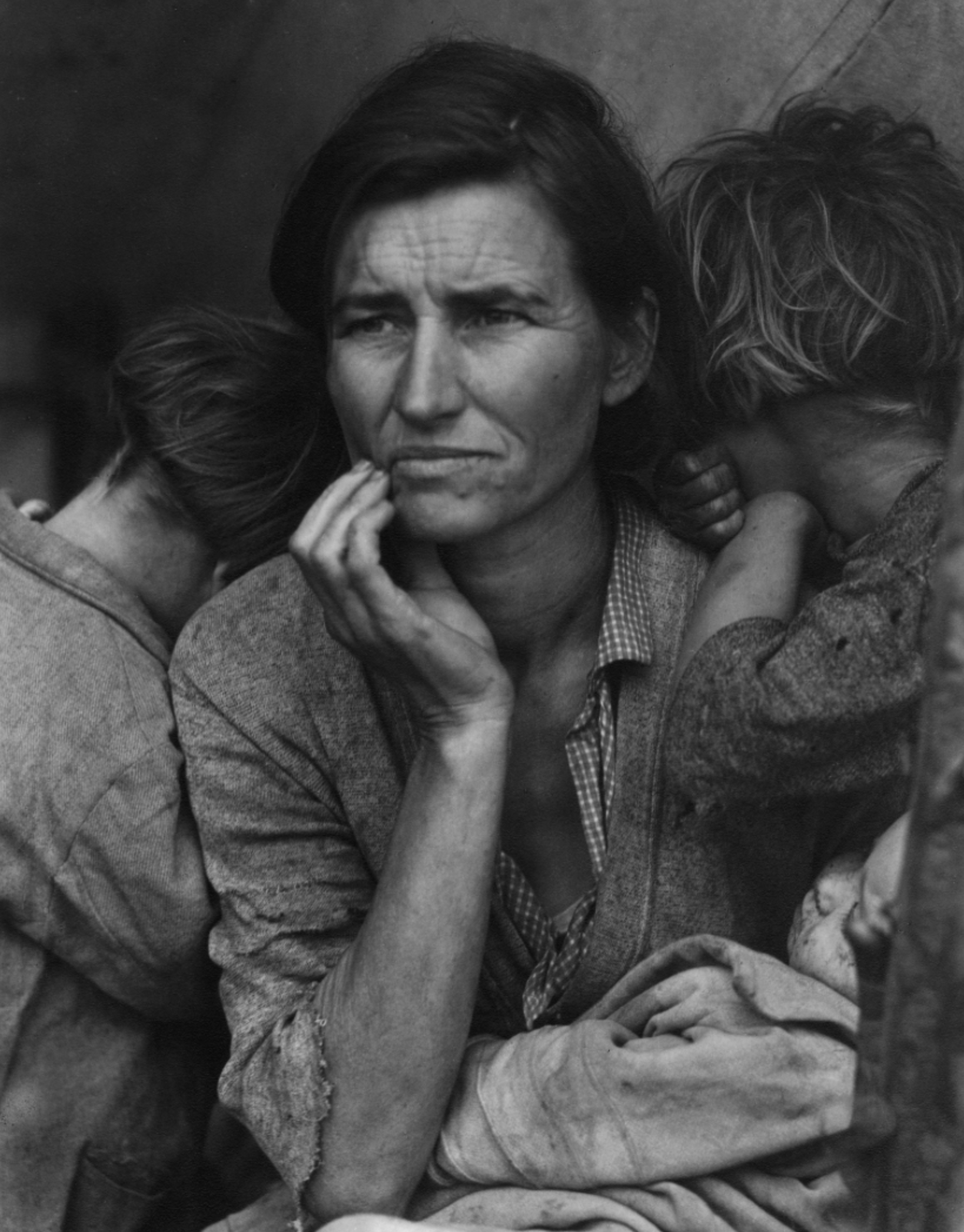
Migrant Mother. 1936.
Oakland Museum of California.
Dorothea Lange was studying to be a teacher when she was introduced to photography in 1913. Three years later, after studying at the Clarence H. White School of Photography, she moved to San Francisco and opened a portrait studio. In addition to her studio work, she began photographing life on the streets of San Francisco. A genre that today we often refer to as “street photography.” There is a connection between street photography and documentary photography in terms of technique. One major difference between the two is that a street photographer is not always tied to one subject matter, where as a documentary photographer is usually hunting for images that illustrate a specific story line.
In 1939, she collaborated with her husband on a book called “An American Exodus,” inspired by the story she discovered while photographing street life.
Much of her best known work was financed by the Farm Security Administration(FSA), which was a federal government agency set up during the Great Depression along with the Works Progress Administration(WPA), to provide financial aid to farmers and to put people to work on public works projects - like building roads and bridges. Lange was hired to photograph the work of these government programs.
The photo leading off this section is known as “Migrant Mother.” It was made at a migrant camp in California in 1936. Lange took several pictures of this woman and her children, but the one above is the one she selected for publication. It has become an iconic image of suffering in the United States during the Depression.
Another major project Lange photographed for the FSA was the incarceration of Japanese Americans in California following the bombing of Pearl Harbor. This assignment put her at odds with those running the FSA because they hoped to use the photos to show the success of the program. Lange, and other photographers - including Ansel Adams - did not see it that way. They saw the incarceration program as inhumane and morally wrong. Lange photographed the story from that perspective and many of her photos were not published until after the war.
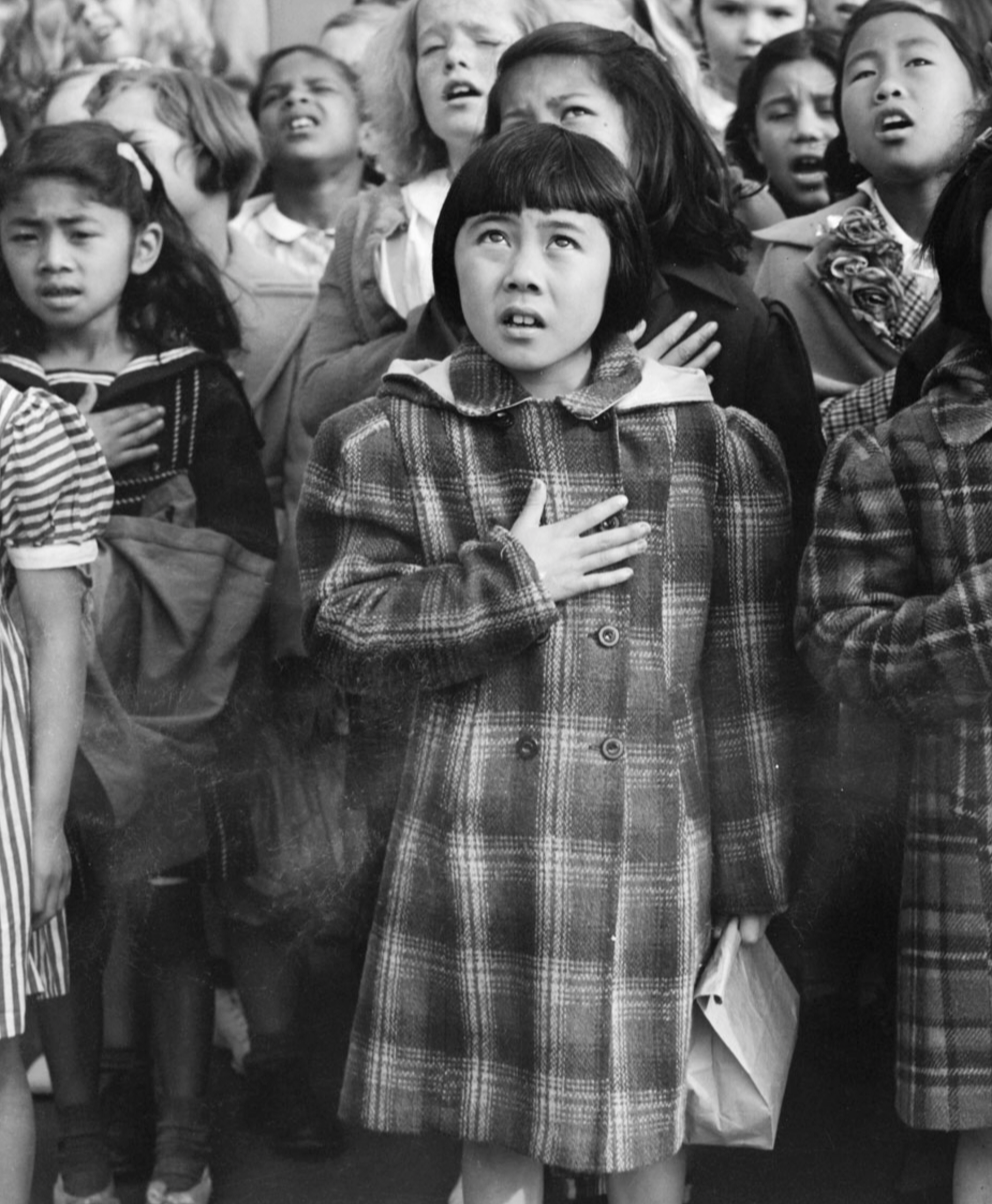
Japanese-American school children reciting the Pledge of Allegiance. April 1942.
Dorothea Lange.
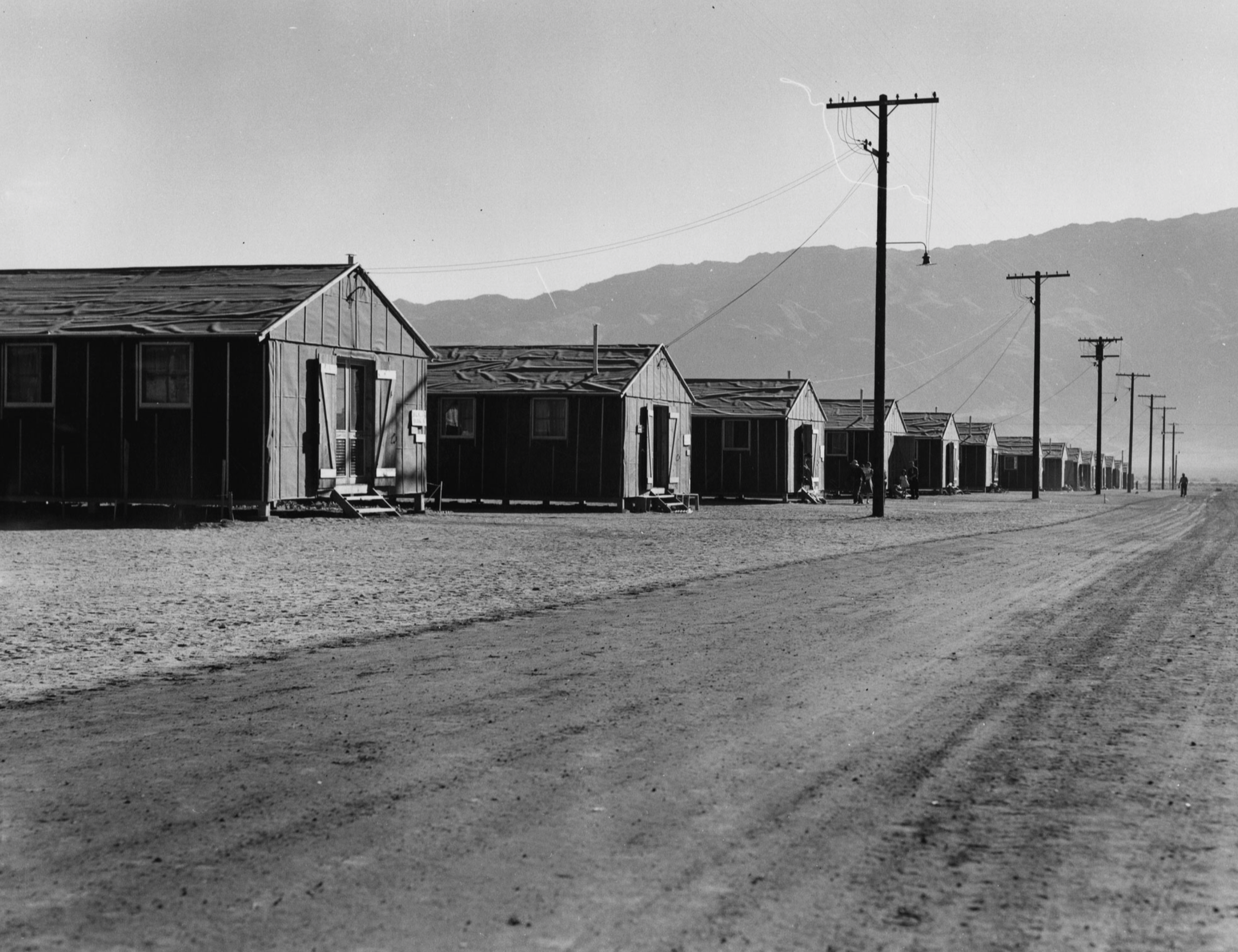
Manzanar Relocation Center, California.
Dorothea Lange, 1942.
Dorothea Lange died of cancer in 1965. In the last year of her life she worked on a retrospective of her work which opened in 1966 at the Museum of Modern Art. Her husband, donated her negatives and about 6,000 prints to the Oakland Museum of California.
Dorothea Lange Digital Archive - Oakland Museum of California
Dorothea Lange Biography - International Center for Photography
Ansel Adams
1902 - 1984
(8)
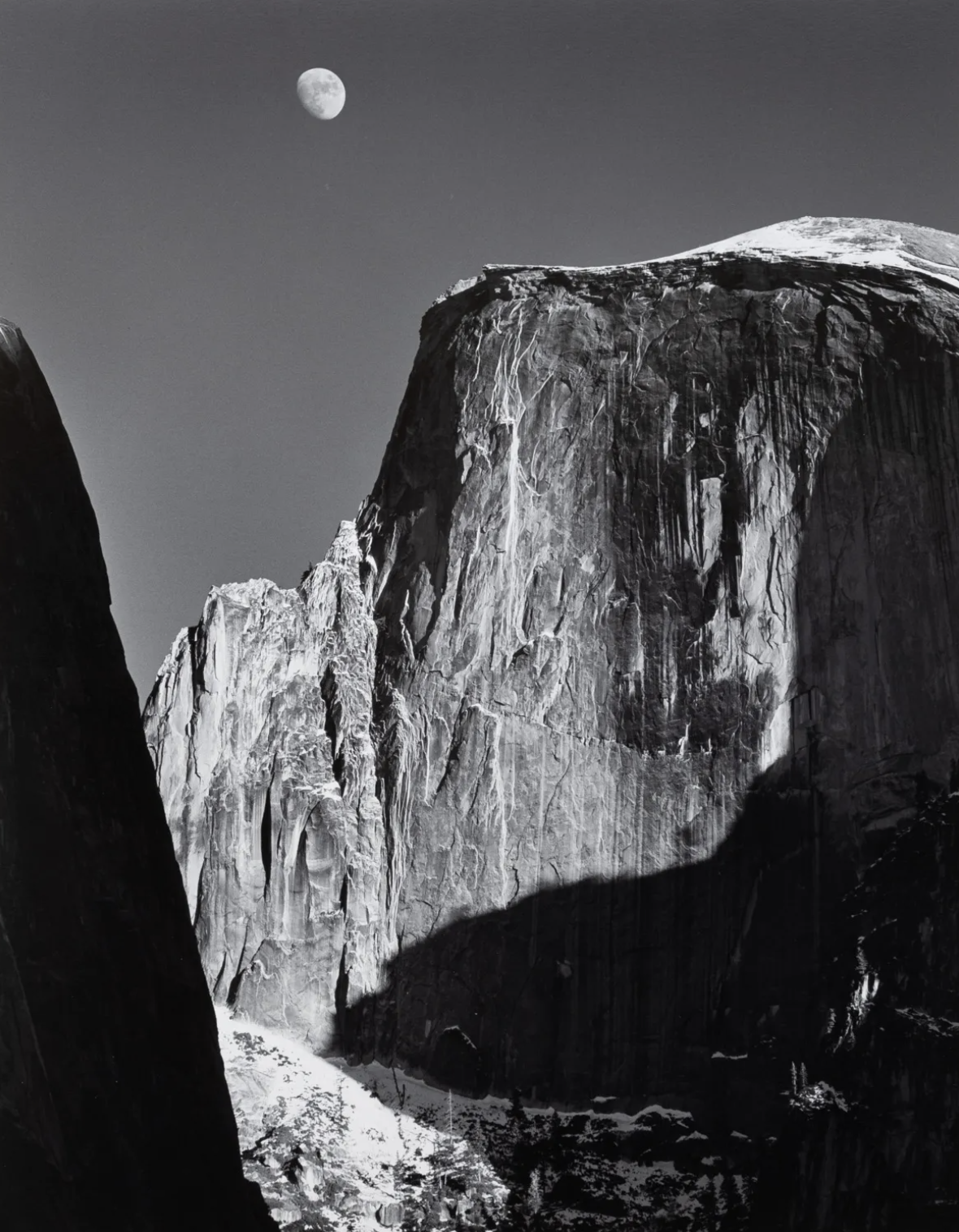
Moon and Half Dome, Yosemite, 1960.
AnselAdams.com
Ansel Adams is perhaps the best known American photographer of the last 100 years and the image at the top of this post - Moon and Half Dome - is perhaps his most famous photograph.
Adams is known best for his black and white photographs of the American west. Throughout his career he used his work to advocate for environmental causes, including the expansion of the U.S. National Park system. His work on that issue in this country influenced the development of national parks in other countries.
He was the founder of a group of photographers known as the F/64 group. They practiced a form they called “pure” photography which included sharply focused images from front to back. He is also given credit for something called the “zone system,” which is an approach to exposure and the developing of photographs in a manner that captured the full range of light within a photo.
Ansel Adams Gallery - AnselAdams.com
Ansel Adams Legacy - CBS Sunday Morning
The reason I have included him in this selection of important photojournalists is because, like Dorothea Lange, he spent the early part of his career working for the Farm Security Administration(FSA). Many of his earliest images can be accessed through the U.S. Library of Congress, because they were taxpayer funded, therefore they are public property, not private property.
Like Lange, he was assigned to cover the incarceration of Japanese Americans in California following the bombing of Pearl Harbor. Like Lange, he found the policy offensive and tried to capture the injustice of the policy rather than make an attempt to justify it through photography.
Ansel Adams Japanese Relocation Photos - U.S. Library of Congress
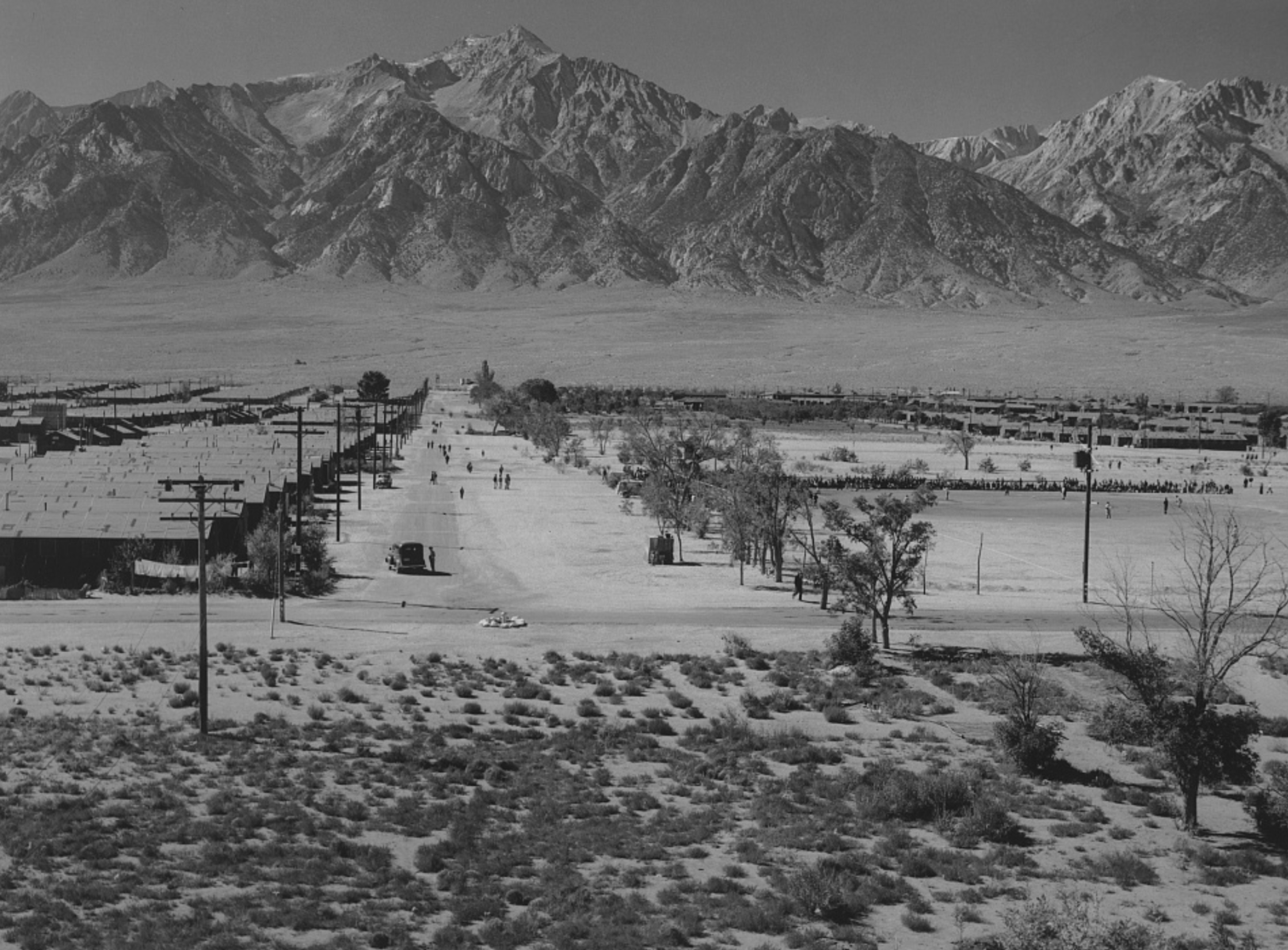
Japanese relocation camp, California. 1943.
Ansel Adams(Library of Congress).
The photo of the Manzanar Relocation Center in Califoria is one of many taken by Adams on behalf of the FSA.
In this photo you can see Adams’s attraction to the landscape as well as the primary subject. You can also see how both he and Lange thought it was important to capture the architecture of the camps to help the audience understand the ramifications of the policy. Many of the relocation camp photos taken by Lange and Adams focus on the behavior of those being held in the camps. Even though they had been unjustly removed from their communities, they continue to believe in the promise of the United States and follow its rules. They never wavered from their general “good citizenship.”
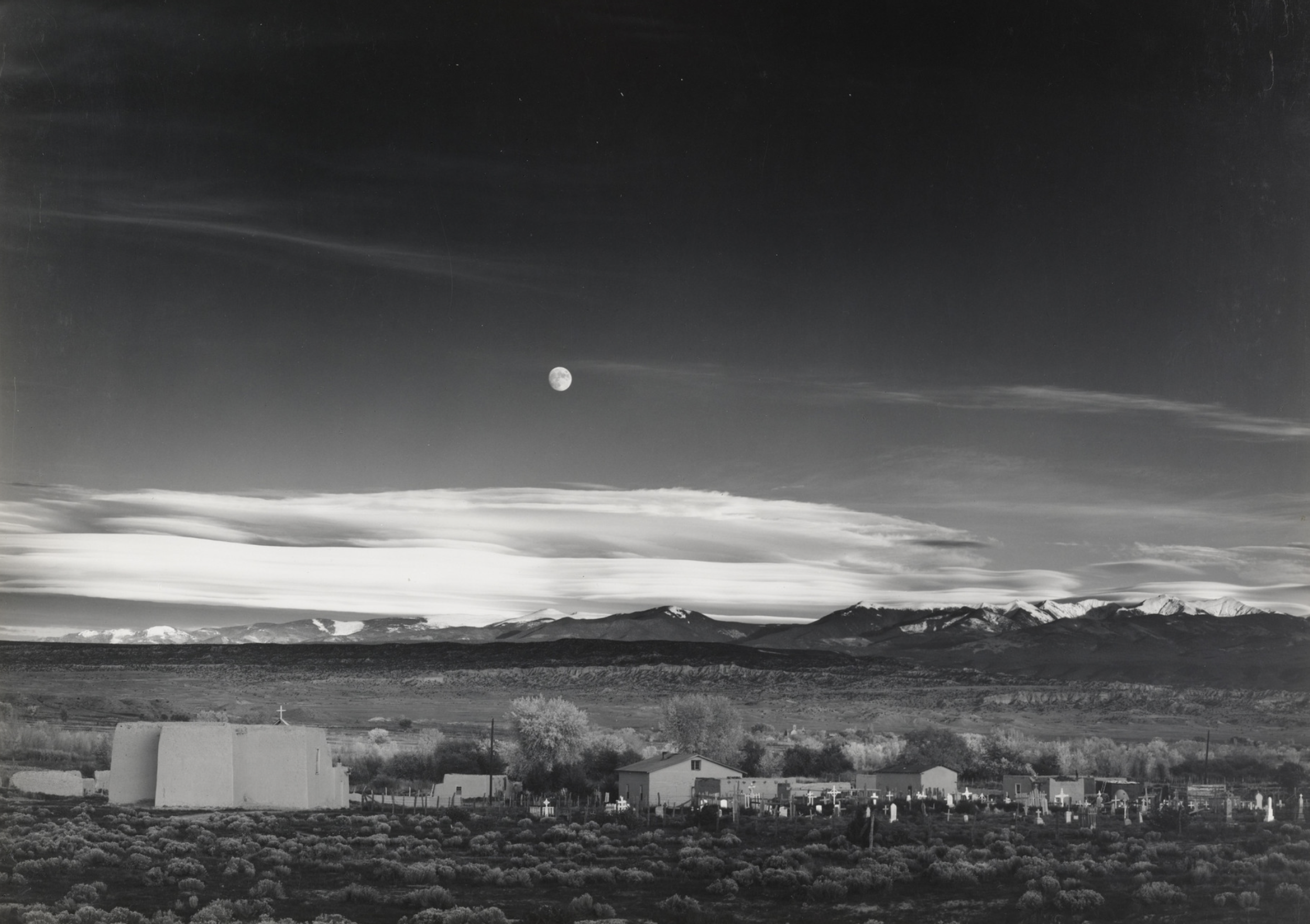
Moonrise, Hernandez, New Mexico, 1941.
Museum of Modern Art.
Moonrise, Hernandez, New Mexico - Museum of Modern Art
The photo known as Moonrise, clearly illustrates the zone system at work. Notice the detail from the foreground of the image all the way to the most distance point.
Lee Miller
1907-1977
(9)
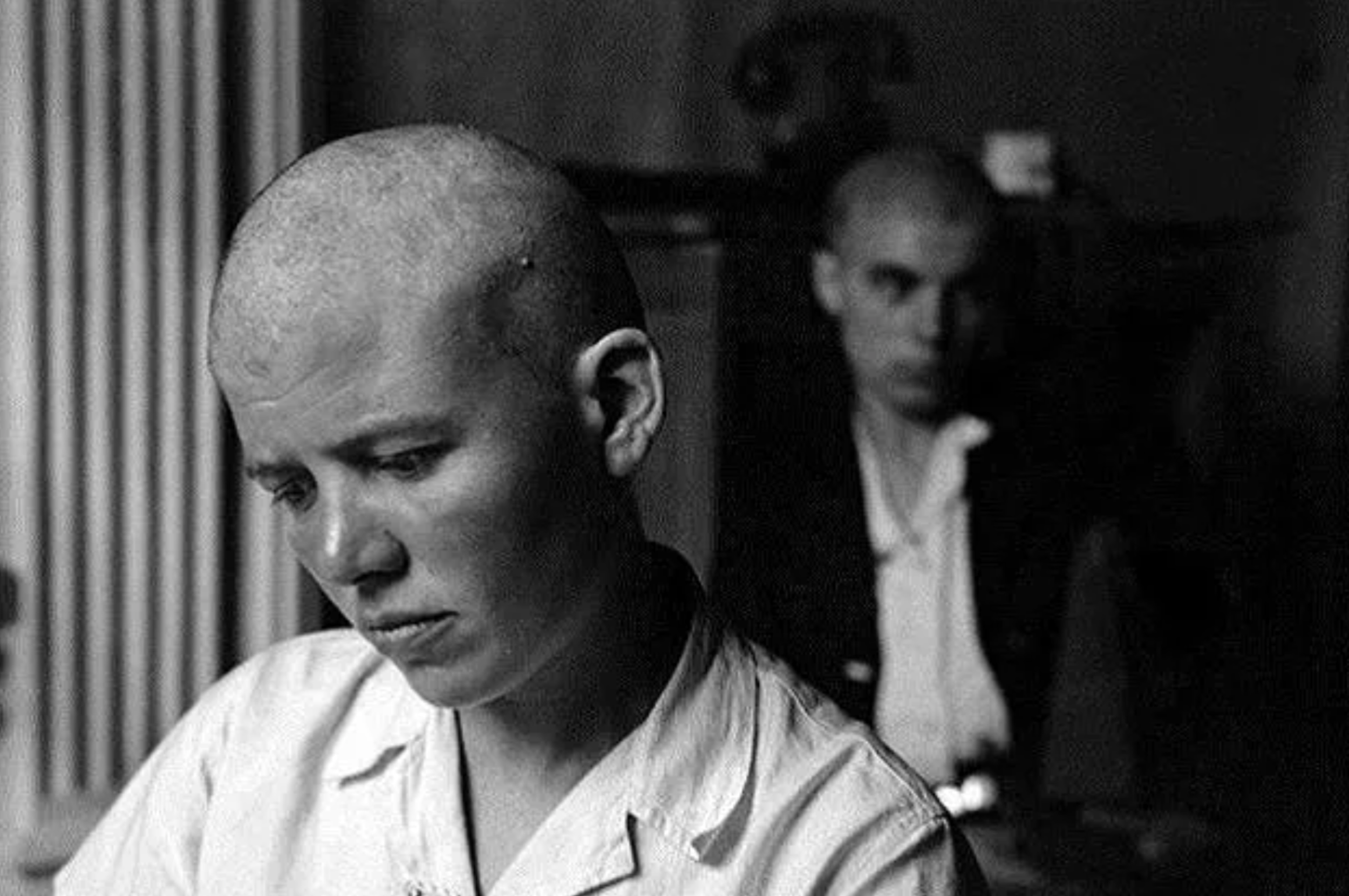
Women accused of collaborating with Germans in France.
Lee Miller, 1944. Lee Miller Archives.
Lee Miller is an interesting photographer who began her career as a fashion model. In fact, we could say she began her career modeling for her father who was an amateur photographer.
In 1929 she moved to Paris, France and began working with the surrealist photographer and artist Man Ray. She soon broke away from his studio and opened her own studio in Paris. She moved back to the United States, opened a studio in New York, then married an Egyptian businessman and moved to Cairo, where she moved away from portrait studio work and began photographing her world from a general perspective.
As the start of World War II approached she moved to Europe, worked with British Vogue - at first as an assistant - and eventually as a freelance photographer and writer. She was one of a few women credentialed by the U.S. government to photograph the war. The government understood that it was important to reach a female audience in order to maintain public support.
She covered many battles during the war, the liberation of concentration camps, and the aftermath of fighting. Some of her best known images include photos of Nazi officers who committed suicide rather than face justice for war crimes and a self-portrait taken in collaboration with fellow photographer David Scherman of Lee Miller in one of Hitler’s bathtubs. She and Scherman often worked and traveled together. He was working for LIFE magazine.
After the war she returned to portrait photography of well known people like the artist Pablo Picasso.
Lee Miller Archives - United Kingdom
Lee Miller’s Second World War - Imperial War Museum(UK)
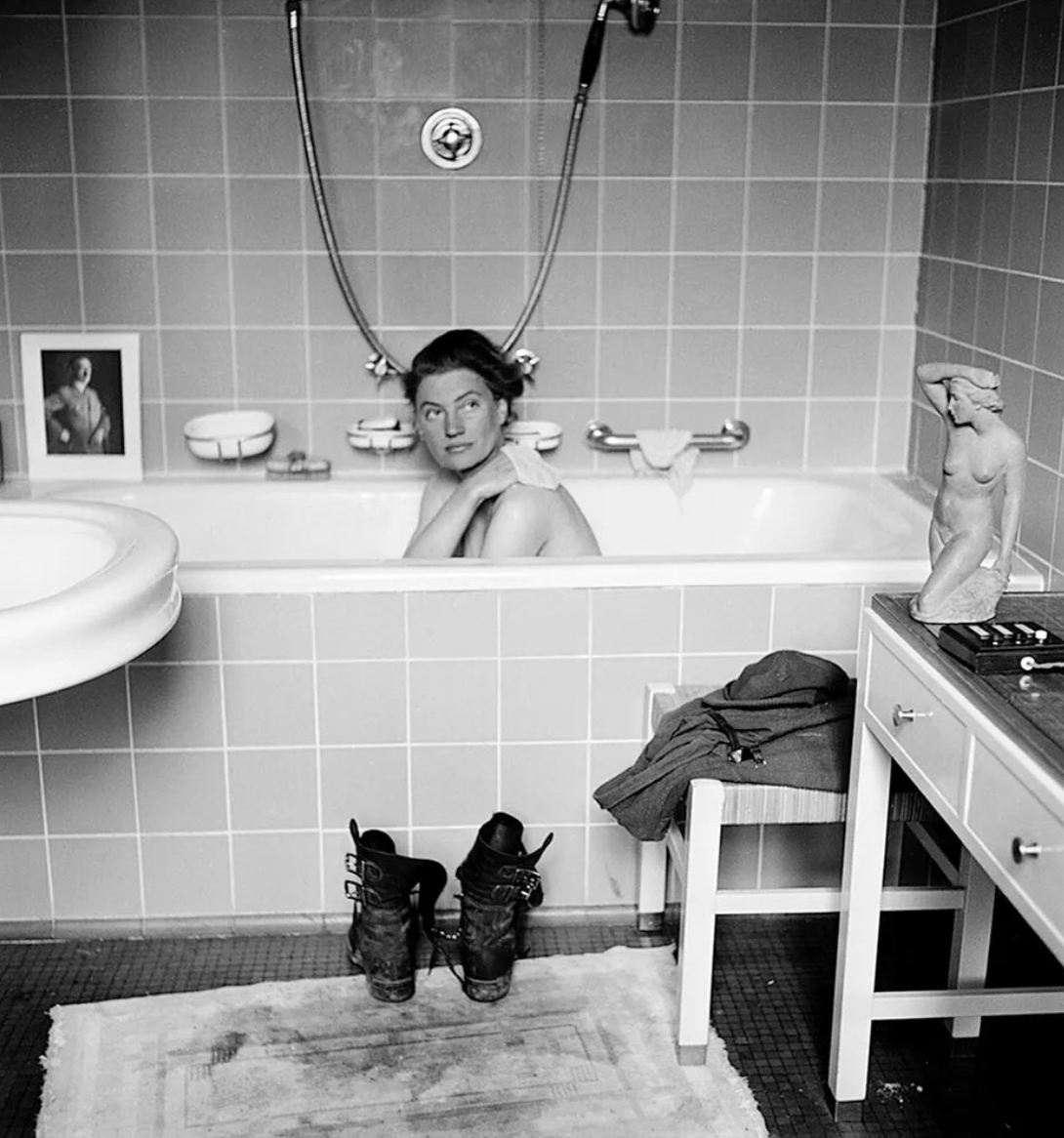
Lee Miller in Hitler’s bathtub.
Lee Miller and David Scherman, 1945. Lee Miller Archives.
Henri Cartier-Bresson
1908-2004
(10)
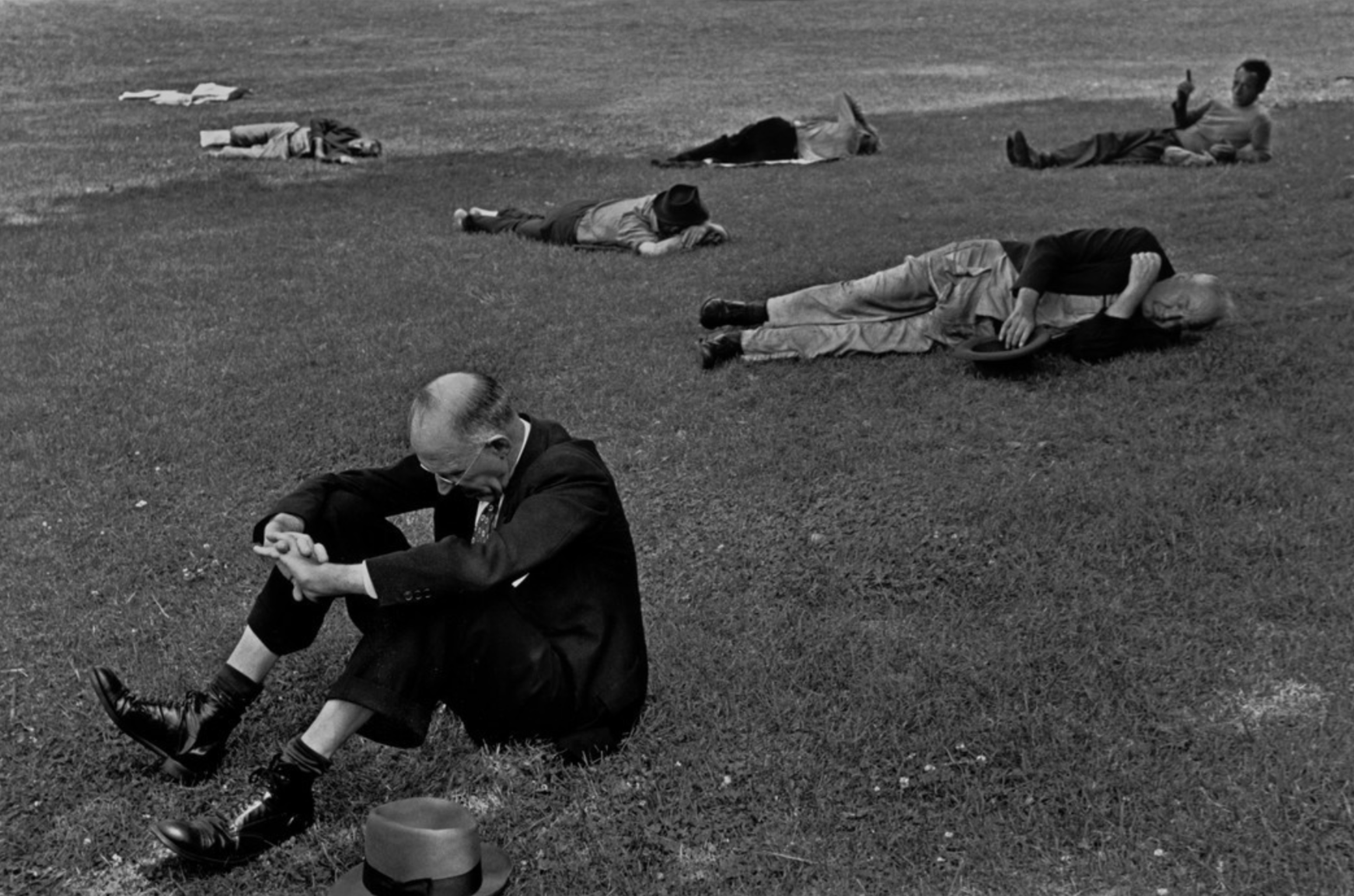
Men relaxing in a Boston park. 1947.
Magnum Photos.
Henri Cartier-Bresson is another photographer who defies traditional classification as a photojournalist. Although he without question engaged in work we consider photojournalism, covering actual news and historic events, he is best known for his slow documentary work covering big subjects over a period of time. Subjects like: The United States, The Europeans, Mexico, etc.
Some of his most famous photos might be classified today as street photography. Almost any history of photography will include Cartier-Bresson.
He was born in France and took an interest in photography in his early 20s. He acquired a Leica 35mm camera which was his go-to instrument throughout his career. Leica’s are small, quiet, and simple to operate.
In 1945, he photographed the liberation of Paris with other notable photographers of the day and after the war, was one of the founding members of the Magnum photo cooperative along with Robert Capa, David Seymour(the subject of earlier posts) and others. He was active as a photographer until the late 1960s, but moved away from photography and toward painting for the rest of his life.
He is known for a book on photographic practice titled “The Decisive Moment”(in English) that was published in 1952.
The photograph taken by Cartier-Bresson that is most associated with the phrase “the decisive moment” is the photo posted below of a man jumping through a puddle. The decisive moment in this case is that moment when the man appears to be suspended in the air with one foot leaving the ladder and the other reaching for the next piece of dry land.
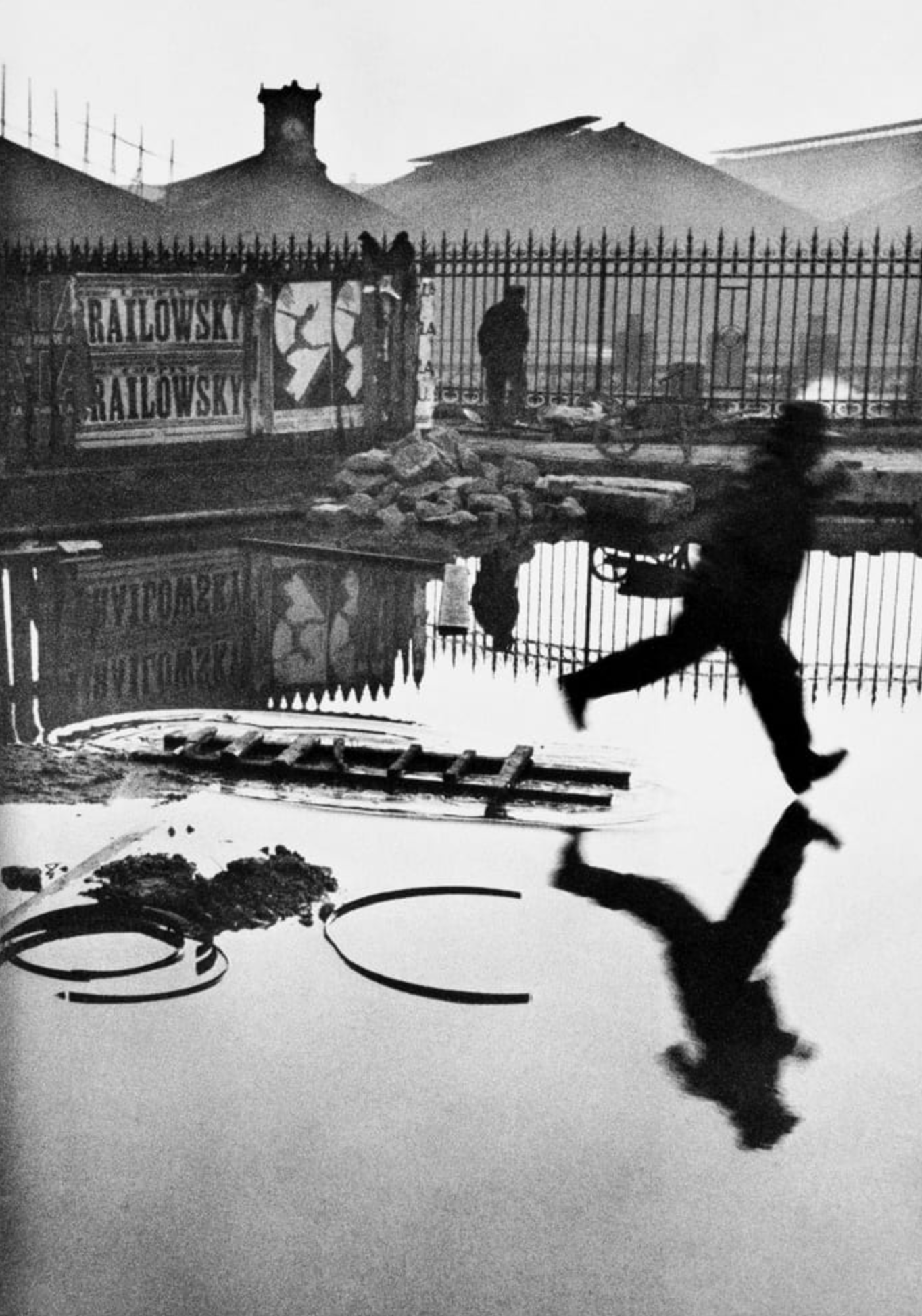
“for me the camera is a sketch book, an instrument of intuition and spontaneity, the master of the instant which, in visual terms, questions and decides simultaneously…”
~ Cartier-Bresson
Henri Cartier-Bresson Bio and Portfolio - Magnum
Four Ways Cartier-Bresson Made Great Street Photography - Tatiana Hopper
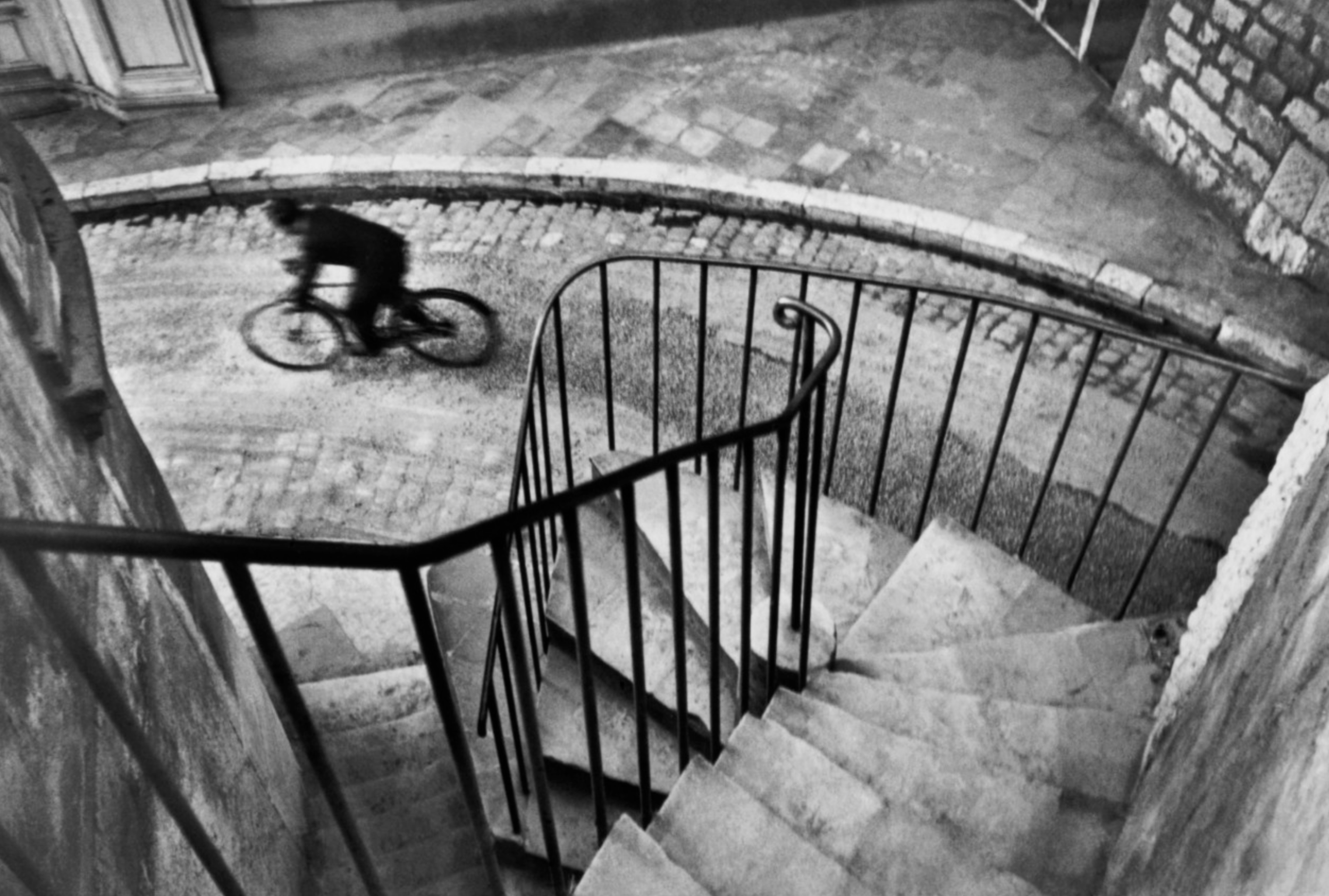
Man on bicycle, 1932.
Magnum Photos.
W. Eugene Smith
1918-1978
(11)
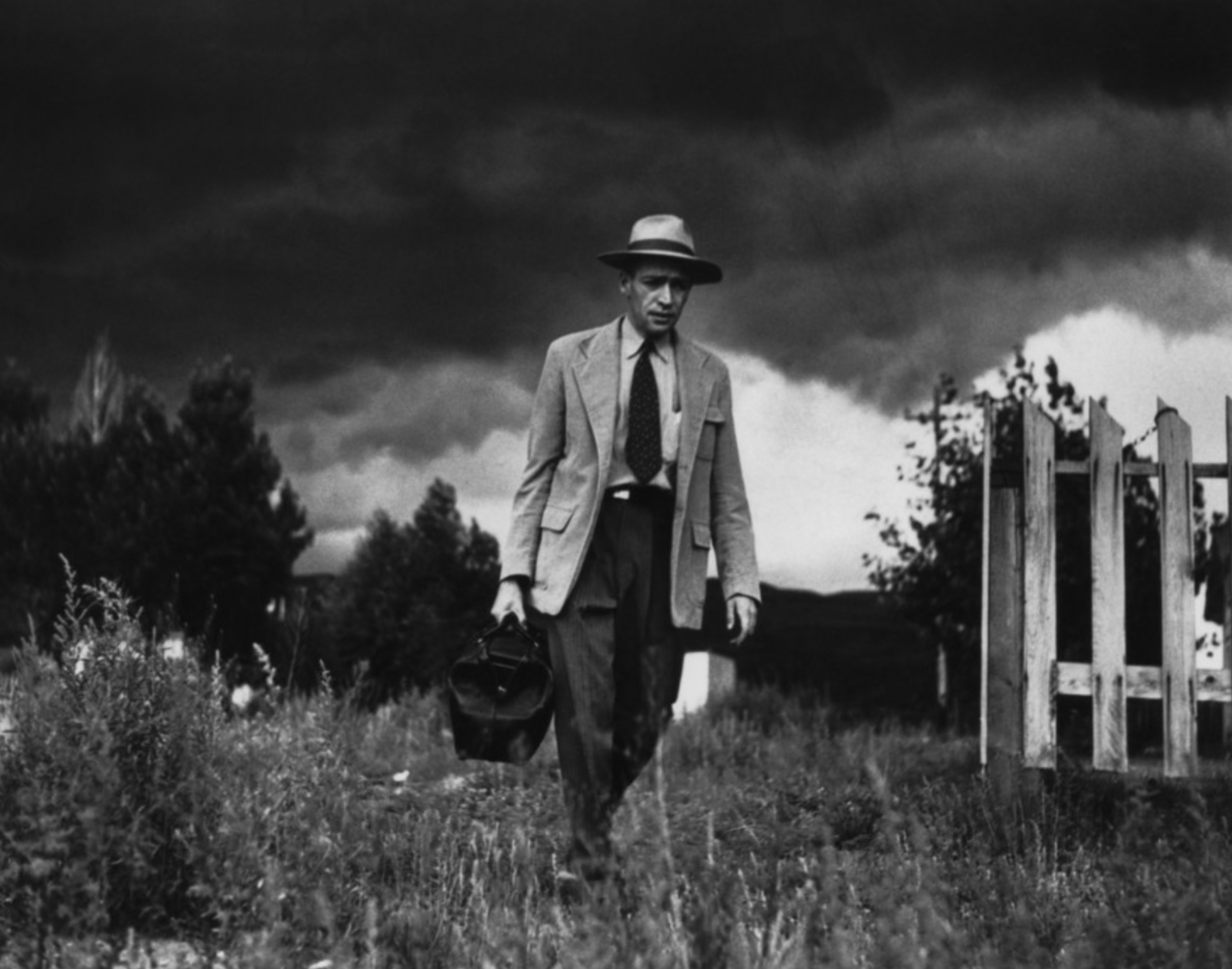
The country doctor, 1948 for LIFE Magazine.
Magnum Photos.
W. Eugene Smith was known for his long form photo essays that required months and sometimes years of work getting to know and getting close to his subjects.
One of his most well-known photo essays was titled “The Country Doctor” and was published by LIFE magazine in 1948. The image above is one of the most iconic photos from the collection.
Smith had a reputation for being stubborn about his approach to his work and some editors refused to work with him.
He began his photography career in high school, working for local papers in Kansas. He then worked for Newsweek and LIFE in the years just before and during World War II.
In 1971, Smith began work on a long-term project in the town of Minamata, Japan. For years a chemical plant had been dumping mercury into a local bay. Both the company and the government denied it was happening and denied that mercury poisoning in the bay had anything to do with the high number of deaths and birth defects in the community. Eventually, both the company and the government admitted wrong-doing and Smith’s photo essay on the subject was published as a “warning to the world” about the effects of industrial pollution.
W. Eugene Smith - Magnum Photos
“Tomoko in Bath” is one of the best known photos from the Minanata photo essay. It portrays a mother bathing her child who was born with severe birth defects as a result of mercury poisoning.
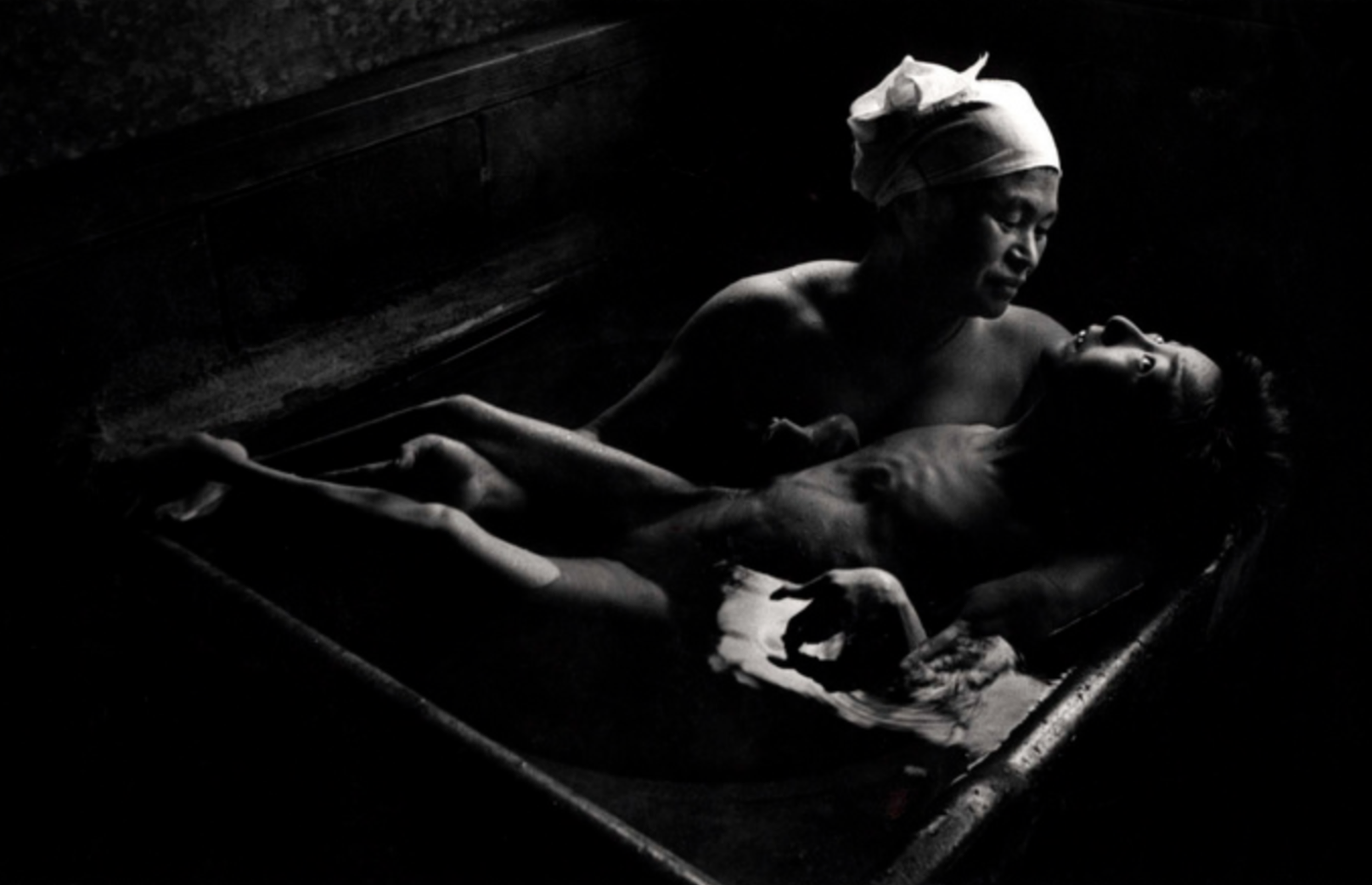
Tomoko in bath, 1972.
Source: International Center for Photography.
W. Eugene Smith Biography and Archives - International Center for Photography
Gordon Parks
1912-2006
(12)
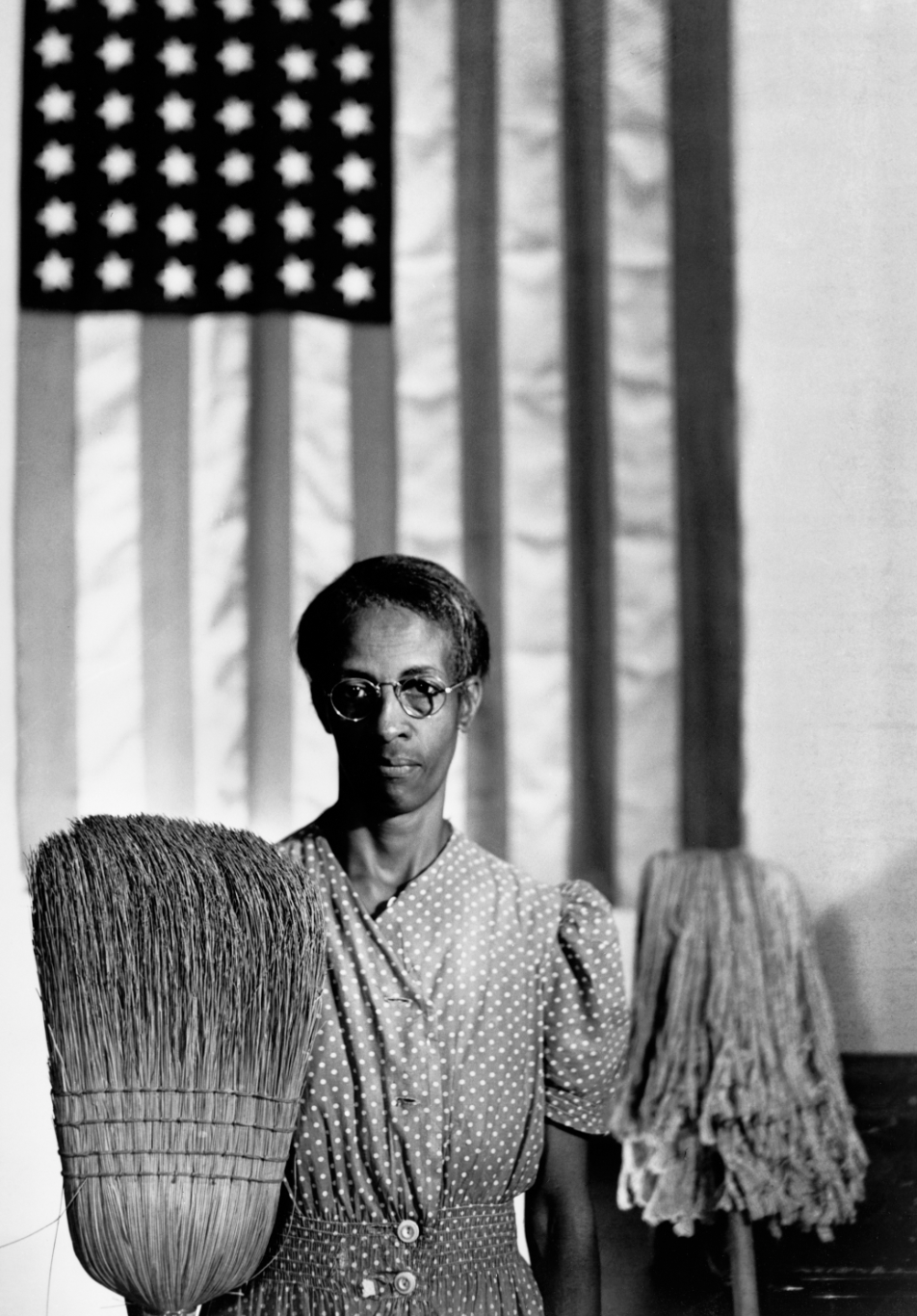
Ella Watson, Washington, D.C., 1942.
Gordon Parks Foundation.
Gordon Parks was born in Fort Scott, Kansas in 1912. His family was considered poor and they lived in a segregated community.
He was drawn to photography after seeing pictures published by the Farm Security Administration(FSA). He bought his own camera from a pawn shop and eventually began working for the FSA himself and later the Office of War Information. In both positions he was asked to photograph the nation’s social conditions which led him to focus on issues of social justice, poverty, racism and other forms of discrimination. After World War II he worked on documentary project for Standard Oil and freelanced for several well known magazines; including fashion magazines, which allowed him to develop his portraiture work.
In 1948 he published a photo essay about a Harlem, New York gang leader in LIFE magazine. He continued working for LIFE for the next twenty years. He was the first Black photographer at LIFE.
Parks was also a writer and filmmaker. He was the first African-American man to write and direct a major film called, The Learning Tree and in 1971 he directed Shaft, which became a cultural touchstone for America - and Black America - in the 1960s and ‘70s.
The first photo in this post, of Ella Watson, is the most well-known image from a small series of portraits of Watson as she lived her life as a cleaning woman in Washington, D.C.
The portrait is staged and is meant to mimic a famous art work known as American Gothic, by Grant Wood, painted in 1930.
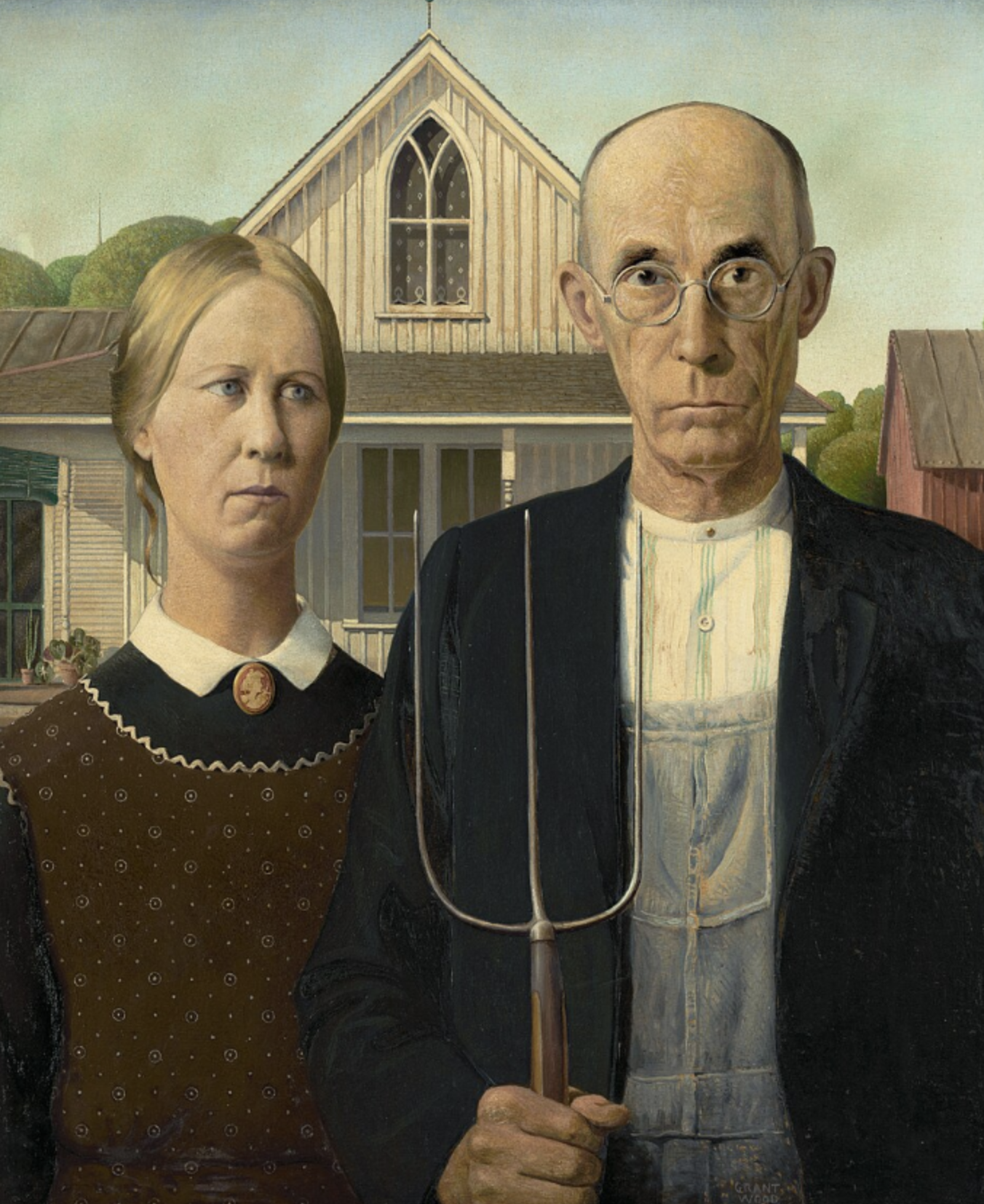
American Gothic.
Grant Wood, 1930.
Parks collaborated with other artists throughout his career. In 1952, he worked with the writer Ralph Ellison for a LIFE magazine photo essay produced to coincide with the publication of Ellison’s book The Invisible Man. That collaboration produced the photo below known as Emerging Man.
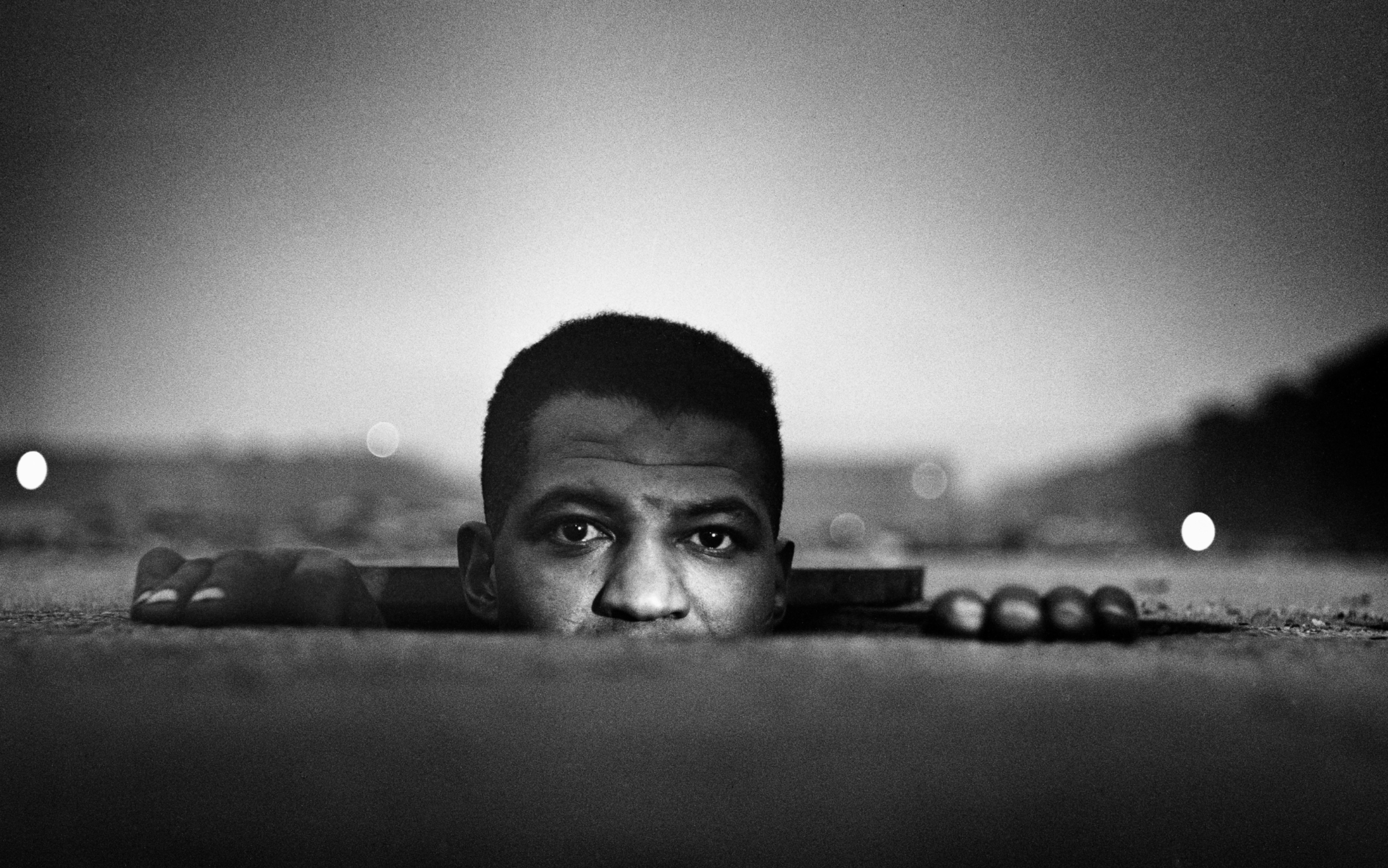
Emerging Man, 1952.
Gordon Parks Foundation.
Parks career spans both straight journalism and art. He does not fit neatly into the catalogue of other photojournalists in this series, but his work also shows how photography can be used to support the written word, illustrate stories, or serve as a story telling device on its own.
There is always a debate in photojournalism about ethics. Is the job of a photographer to simply record events, or at times is it acceptable to use the tool of photography to better explain an issue, even if that means the subject of the photograph is manipulated in some way.
Biography and Work - TheGordonParksFoundation.org(An excellent resource)
Ella Watson 1942 - TheGordonParksFoundation.org
Harlem Gang Leader - TheGordonParksFoundation.org
Fashion: 1948-1961 - TheGordonParksFoundation.org
Video
Parks’s Empathetic Approach - Pace Gallery
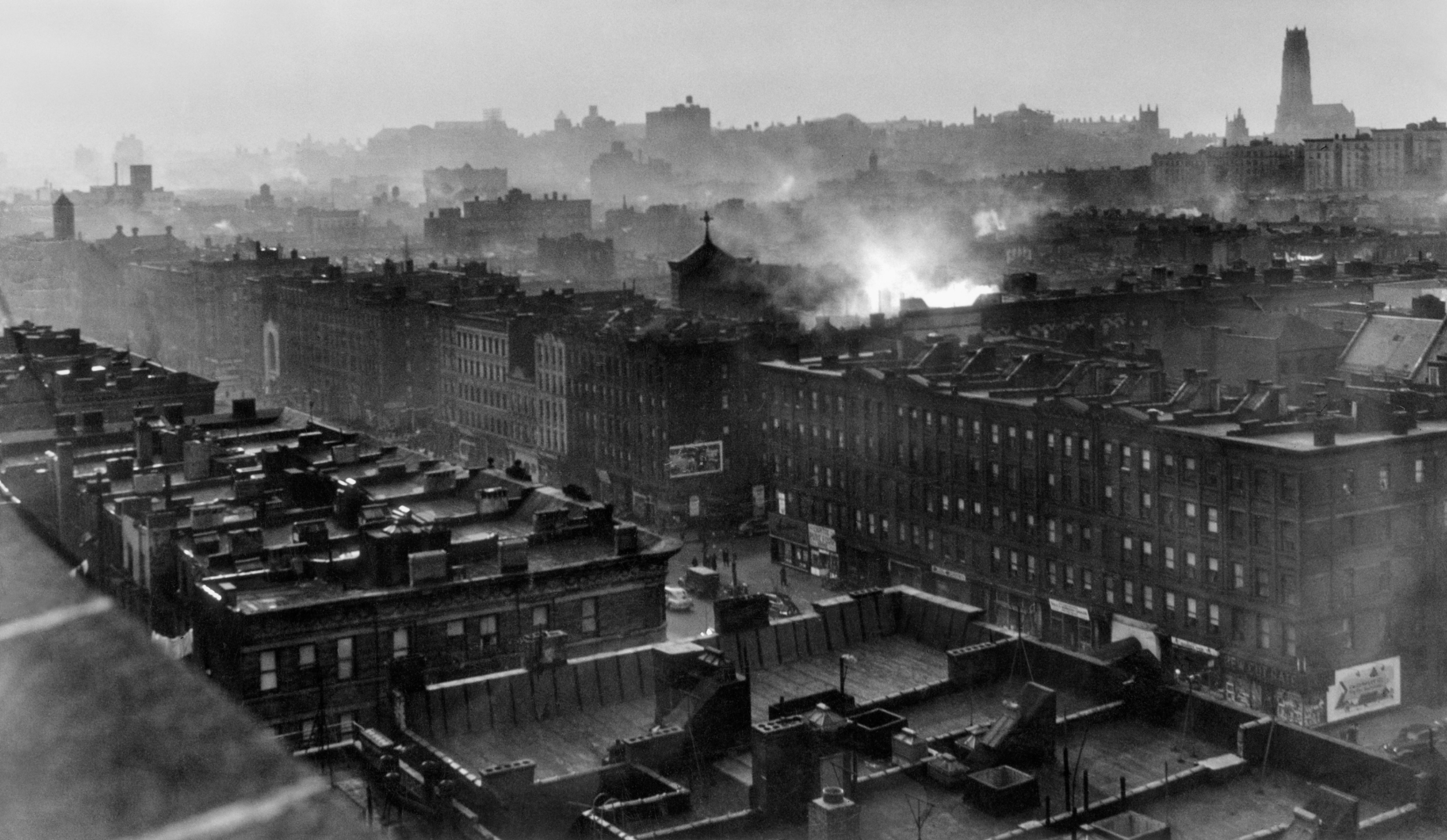
From a LIFE photo essay on a Harlem gang leader. 1948.
Gordon Parks Foundation.
Dickey Chapelle
1919-1965
(13)
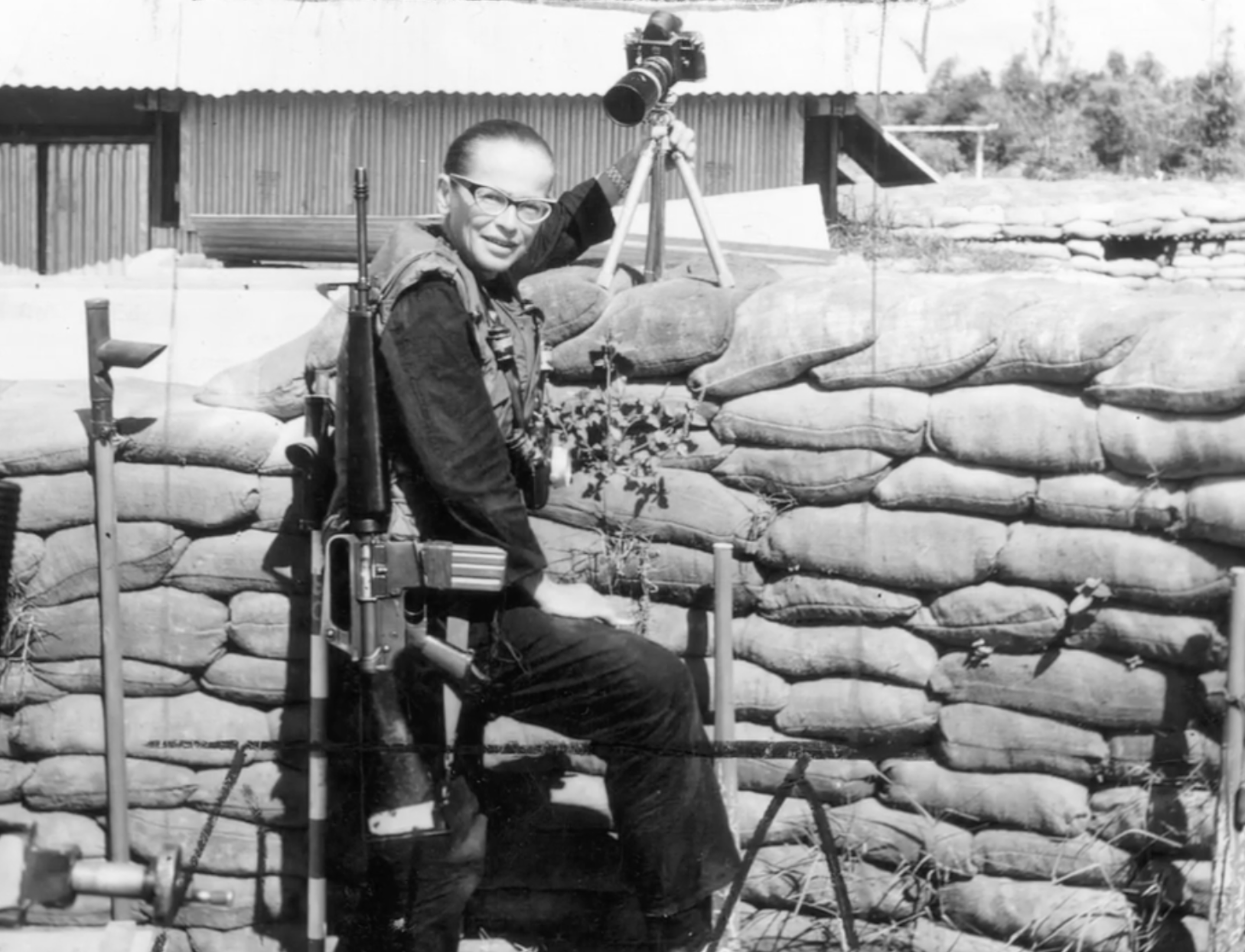
Dickey Chapelle, 1964.
Vietnam-Cambodia border.
Born Georgette Louise Meyer, in Milwaukee, Wisconsin, the woman who came to be known as Dickey Chapelle, was one of the first American women photojournalists to cover war. She began her career as a combat photographer during World War II. Her career ended in 1965 in Vietnam when she was hit by shrapnel from a boobytrap set off by a soldier walking in front of her.
In addition to WWII and Vietnam, Chapelle covered stories in India and Africa and fighting in Hungary and Cuba. She was credited with taking a photograph that showed the first American soldier fighting in the Vietnam War along with South Vietnamese troops. At the time, the U.S. government was not acknowledging the country had forces in the field. The photo was published in National Geographic magazine.
Like many of the photographers we have considered in this series, Chapelle did not take an obvious path into journalism. She originally attended M.I.T. to study aircraft design and then decided she wanted to be a pilot herself. She began taking photography lessons while working in the public relations department of TWA Airlines. Her work was recognized by the New York Times and National Geographic and her photography career took off.
She was committed to being as close to the action as possible - an approach that probably contributed to her death on the battlefield.
Inside the Daring Life of a Forgotten Female War Photographer - National Geographic
The Brilliant Photos of the First Female War Photographer Killed in Action - Washington Post
(If this link does not work, a PDF is available in Canvas)
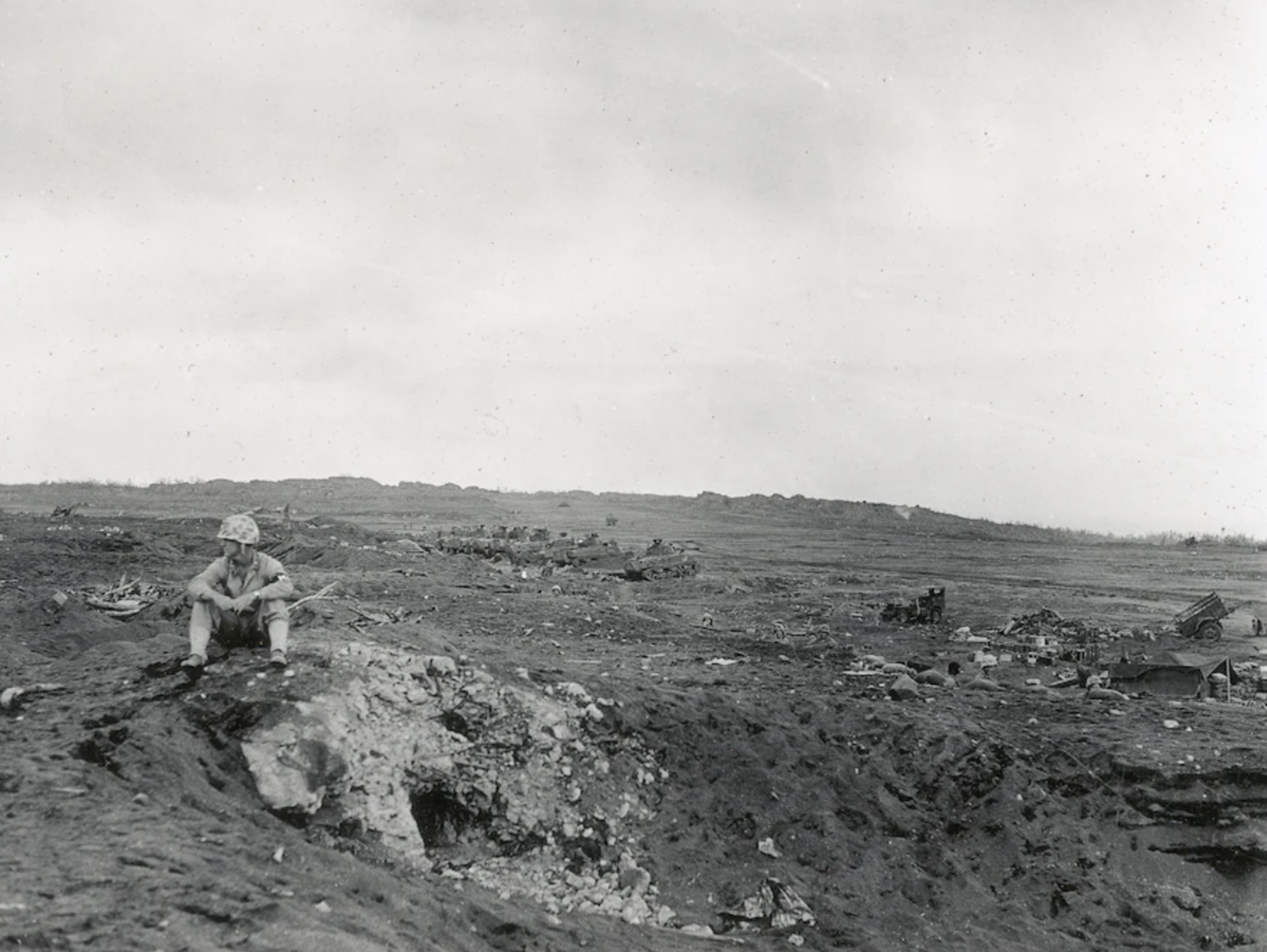
A U.S. soldier nine days after the first assault on Iwo Jima in the Pacific in WWII.
Photo: Wisconsin Historical Society.
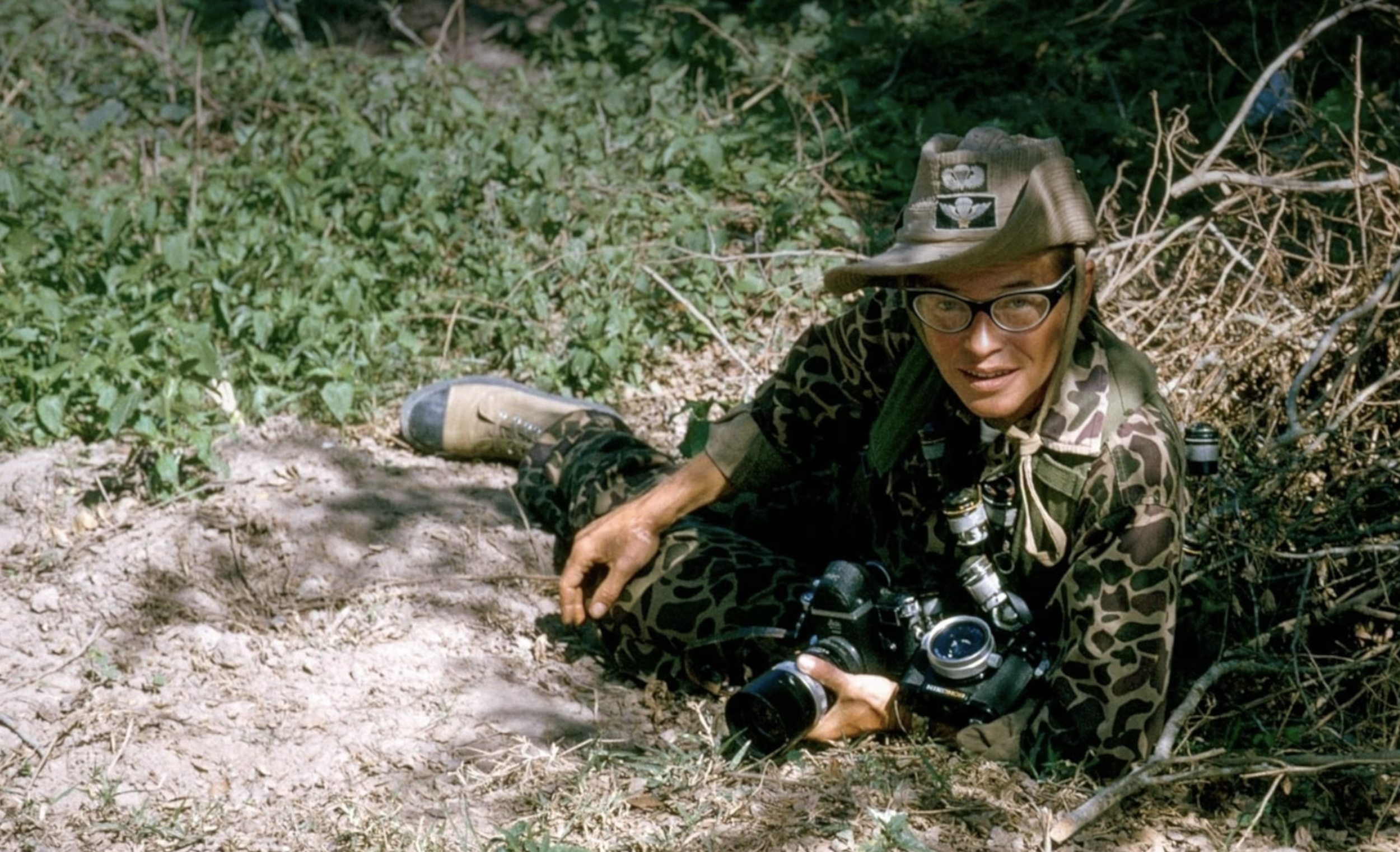
Photo: National Geographic.
Eddie Adams
1933-2004
(14)
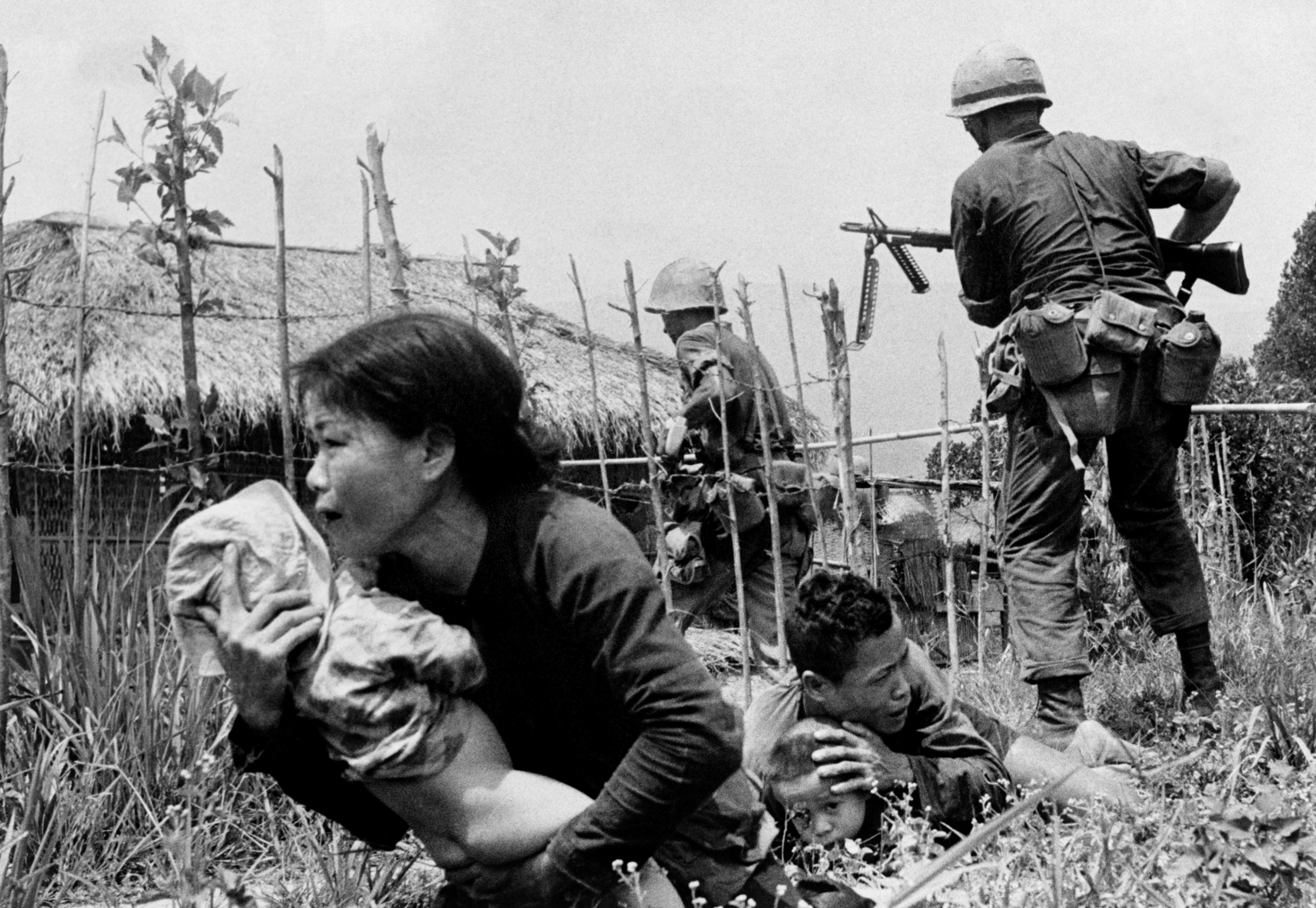
Vietnam 1965.
Adams said this was his “favorite” photo of the war.
Eddie Adams was born in Pennsylvania and began his photography career with his high school newspaper. He was a U.S. Marine photographer during the Korean War and when he returned home worked for several papers in his home state until he joined the Associated Press as a photographer in 1962. Over the next several decades he covered the war in Vietnam and conflicts in at least twelve other war zones around the globe. He covered seven U.S. presidents and photographed many world leaders. At different times he worked for TIME magazine and Parade magazine. Parade was a weekly supplement in the Sunday editions of many U.S. newspapers.
His most famous photograph caught the moment when the South Vietnamese National Police Chief executed a North Vietnamese soldier in the streets of Saigon. I have not included the photo in this post, because of its graphic nature, however, it is the focus of much of the commentary in the links I have included. Adams is one of the most celebrated news photographers of his era. Before he died he started an annual workshop for aspiring photojournalists at his home in upstate New York. It is still in operation today. The archived collection of his work was donated to the University of Texas at Austin.
With regard to the execution photo that made him famous, Adams had mixed feelings. At the time the photo was taken, he says he thought nothing of it. At that point in his career he had seen lots of violence and death. But coming as it did in the middle of America’s involvement in Vietnam, the photo had a dramatic effect on public opinion in the United States. Adams’ photo and another taken by Nick Ut - which is the subject of the next post - helped turn the tide against U.S. involvement in the war. Both images made Americans question whether the war was just or winnable.
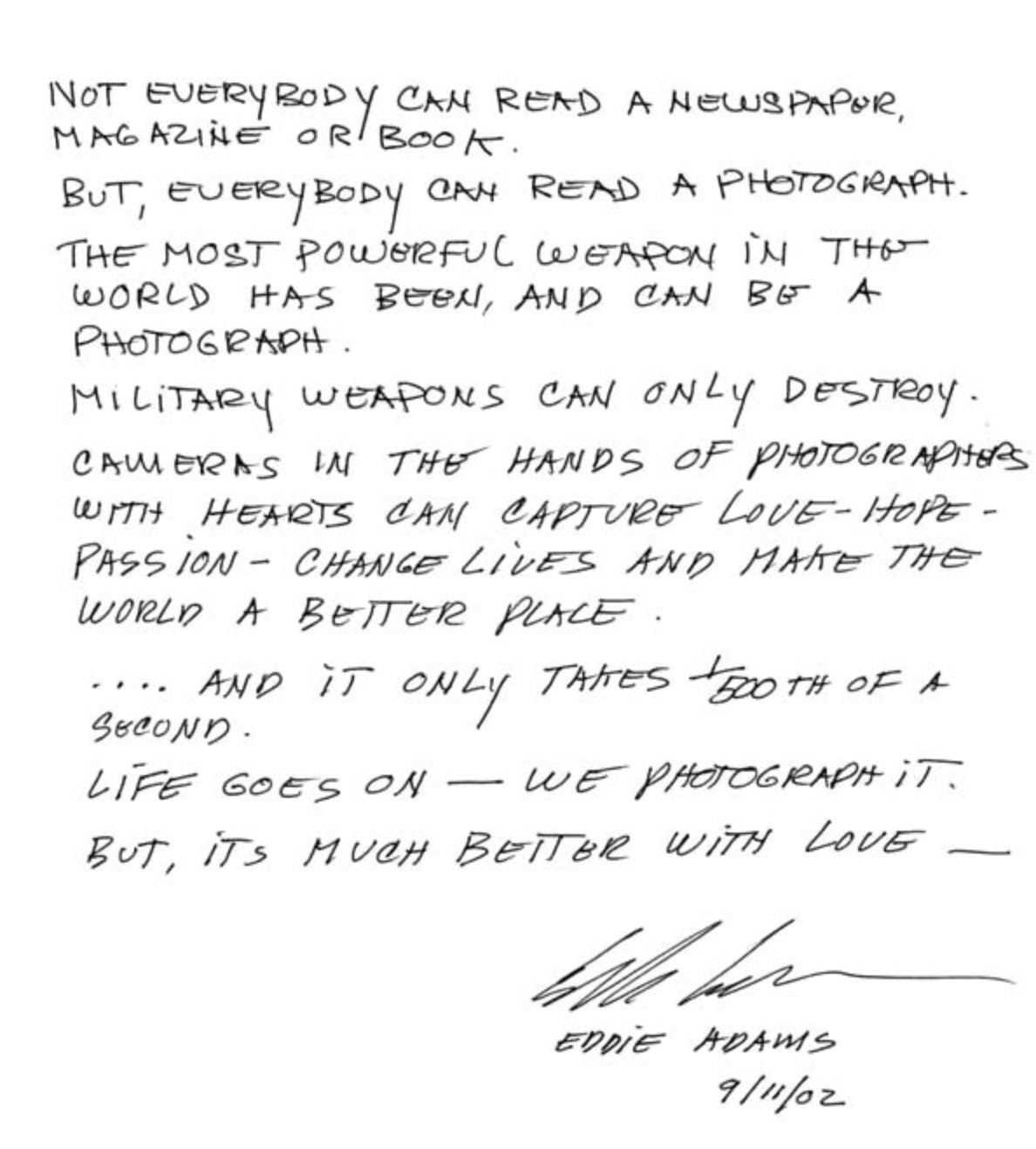
This handwritten note on the power of photographs is included on the website of the Eddie Adams Workshop.
A Short Portfolio of Adams’ Work - The Eddie Adams Workshop
One Bullet, One Photo - A Thousand Words
Eddie Adams, Oral History of the Execution Photograph - Associated Press
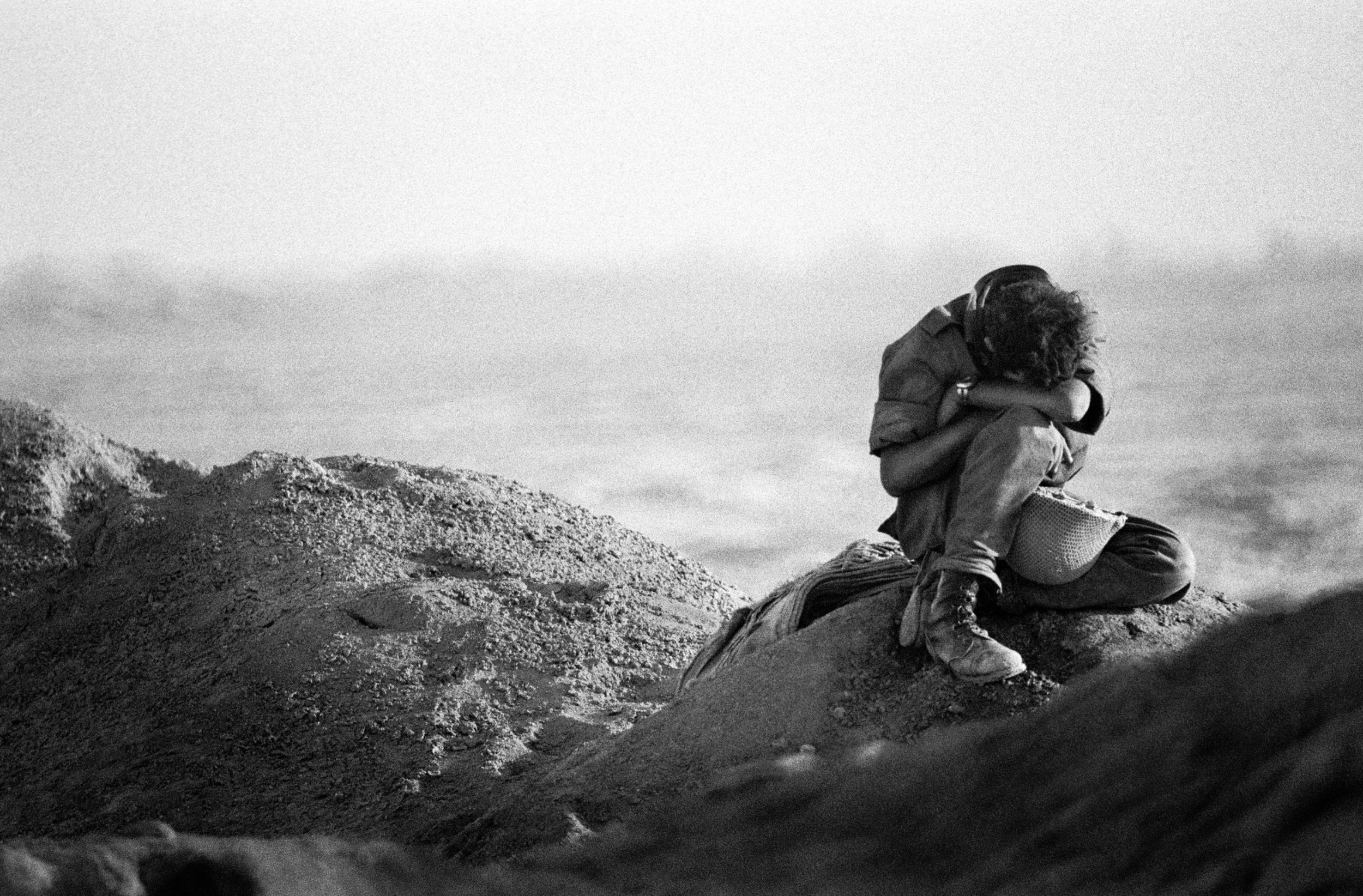
Lone Israeli soldier, Yom Kippur War, 1973.
Nick Ut
1951 -
(15)
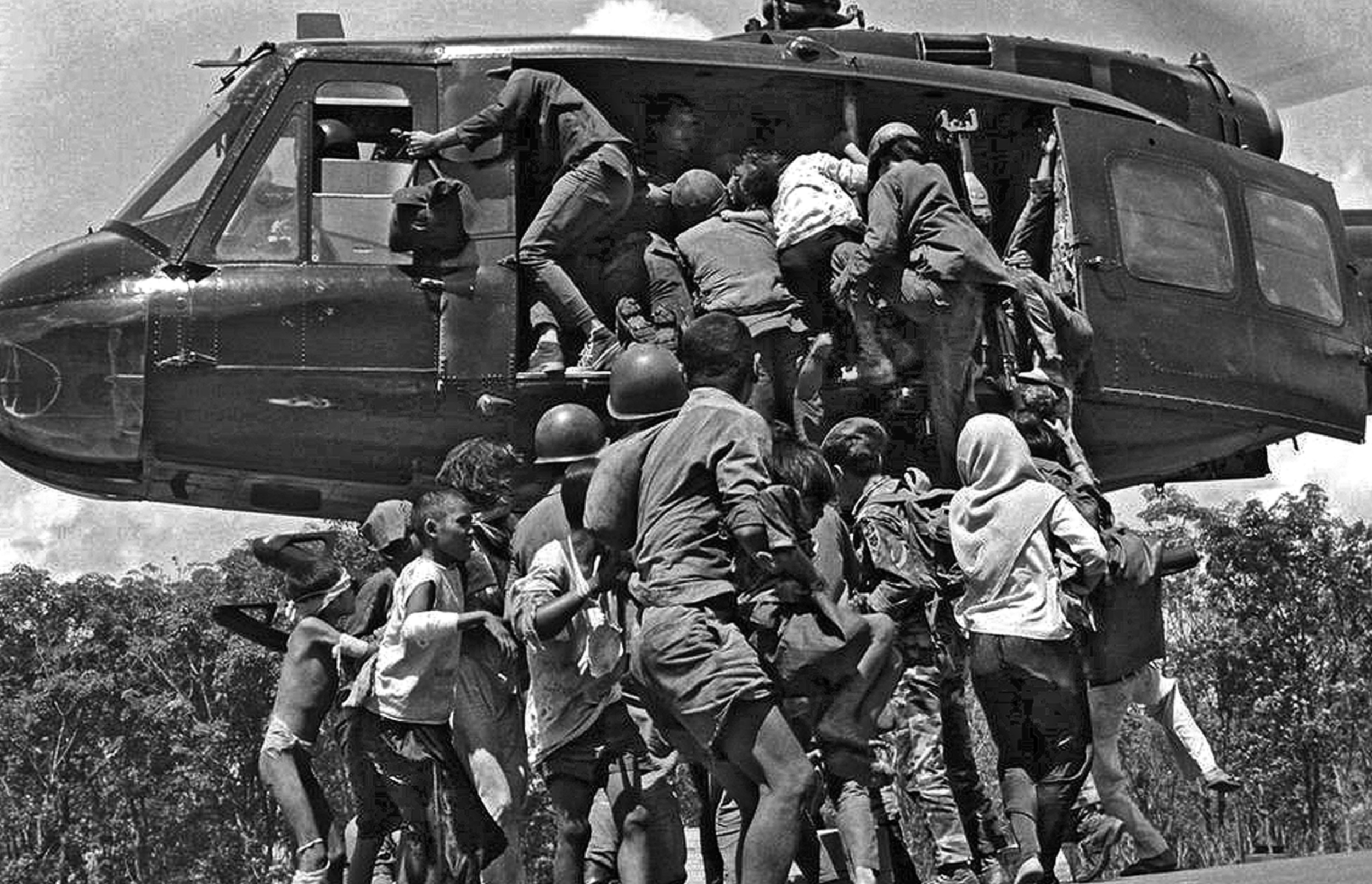
Nick Ut(pronounce: oot) began work as a photographer in Vietnam when he was only 15 in 1966. His brother was an AP photographer who was killed in action the previous year. Ut essentially took his brother’s place.
Ut covered the war until its end. He was wounded in covering combat in 1970. After the war he moved to Tokyo to continue his work for the AP and was eventually transferred to Los Angeles where he spent most of his career. In addition to his combat photography, he taken many pictures of celebrities and major stories on the west coast of the United States.
Like Eddie Adams, Ut took one of the photographs that some say helped end American involvement in the war in Vietnam. In June of 192, Ut photographed a nine year old girl running naked to escape a napalm attack. At first the AP and some American newspapers refused to carry the photo because the main subject was naked, but eventually the photo was distributed and published worldwide. Like the Adams execution photo, Ut’s photo had a negative effect on public opinion toward the war in this country. (As with the Adams photo I have not included the “Napalm Girl” photo in this post, but it is the main subject of many of the links I have included).
Nick Ut - From Hell to Hollywood - Leica Store L.A.
*Leica is a camera brand used by many photographers from World War II through Vietnam and remains a very high end camera brand. I am using this link because it includes a good collection of Ut’s work and a video in which he discusses his most well known photo).
Nick Ut Interview - Lens Magazine
50 Year Anniversary of Napalm Girl Photo - CNN
How Napalm Girl Photo Changed the War - NBC News
Unfortunately, Ut’s career is currently the subject of some controversy. A documentary has been produced questioning whether the Napalm Girl photo was taken by him, or by a freelance photographer. The Associated Press has done an investigation into the claims and has found no evidence Ut did not take the photo.
Larry Burrows
1926 - 1971
(16)
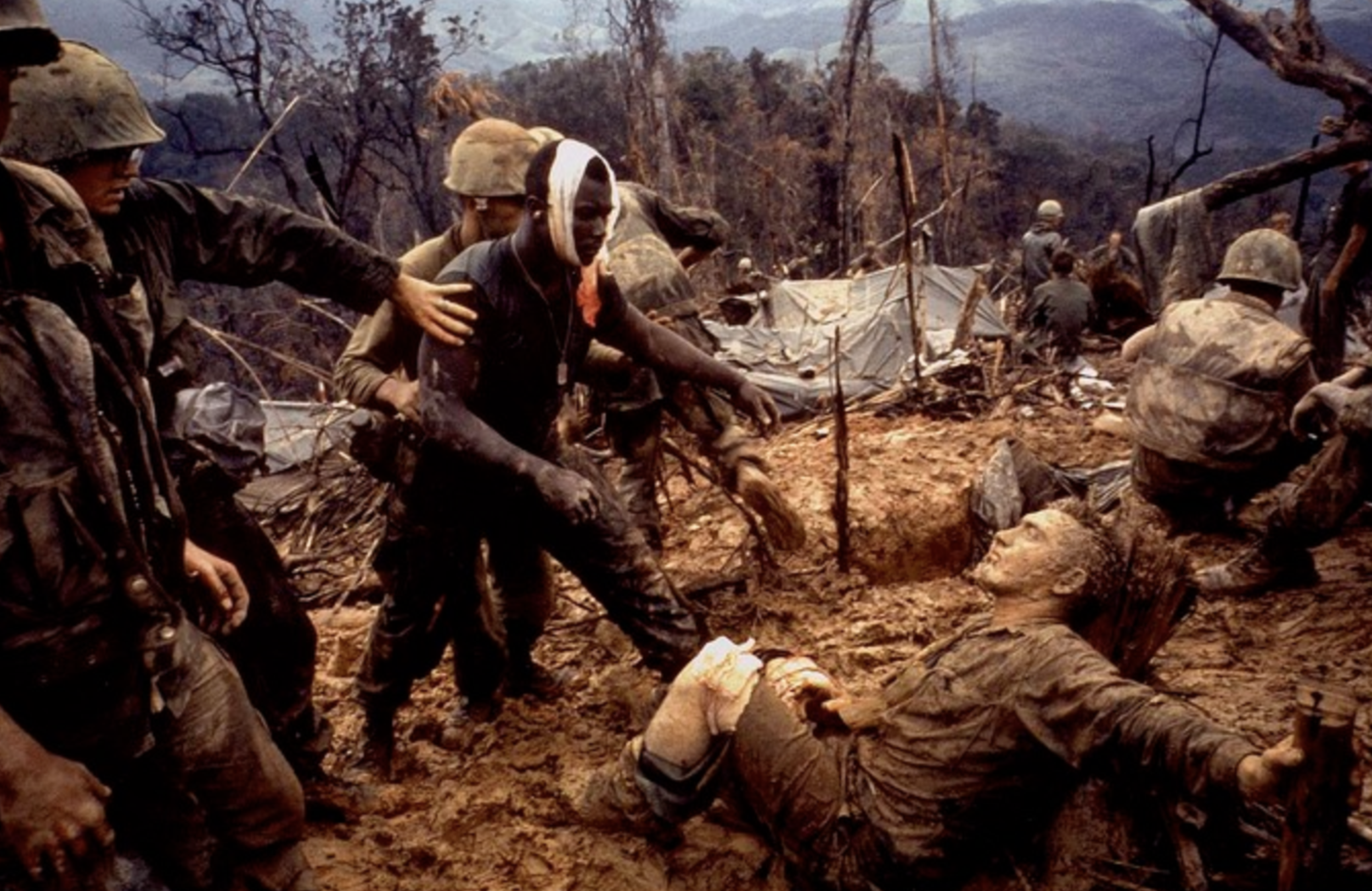
“Reaching Out.” Vietnam, 1966.
LIFE Magazine.
Larry Burrows was a British photographer who began his career in England working for newspapers. Eventually he began working as a photographer and was hired by LIFE magazine. He covered several conflicts during his lifetime, but his most well-known images were taken in Vietnam.
His photos are known for their color and their close proximity to the action. Like Robert Capa in World War II and Dickey Chapelle in the early to mid-’60s, Burrows believed it was important to be as close to the troops as possible. In 1971, while on a mission embedded with American troops, the helicopter he was in was shot down and he was killed.
Many of Burrow’s photos during the war were published as full photo essays in the pages of LIFE. Many were cover stories.
Photojournalism was probably at its peak during the Vietnam era. Cameras had become highly portable. Newspapers and magazines were still a dominant force in journalism. Television had not yet come into its own as a main way people consumed their news. And of course, there was no social media. This combination of factors made photos from the war extremely effective in moving public opinion.
Larry Burrows Bio and Portfolio - International Center for Photography
The Series of Photos Taken With “Reaching Out” - LIFE magazine
Larry Burrows Bio - LIFE
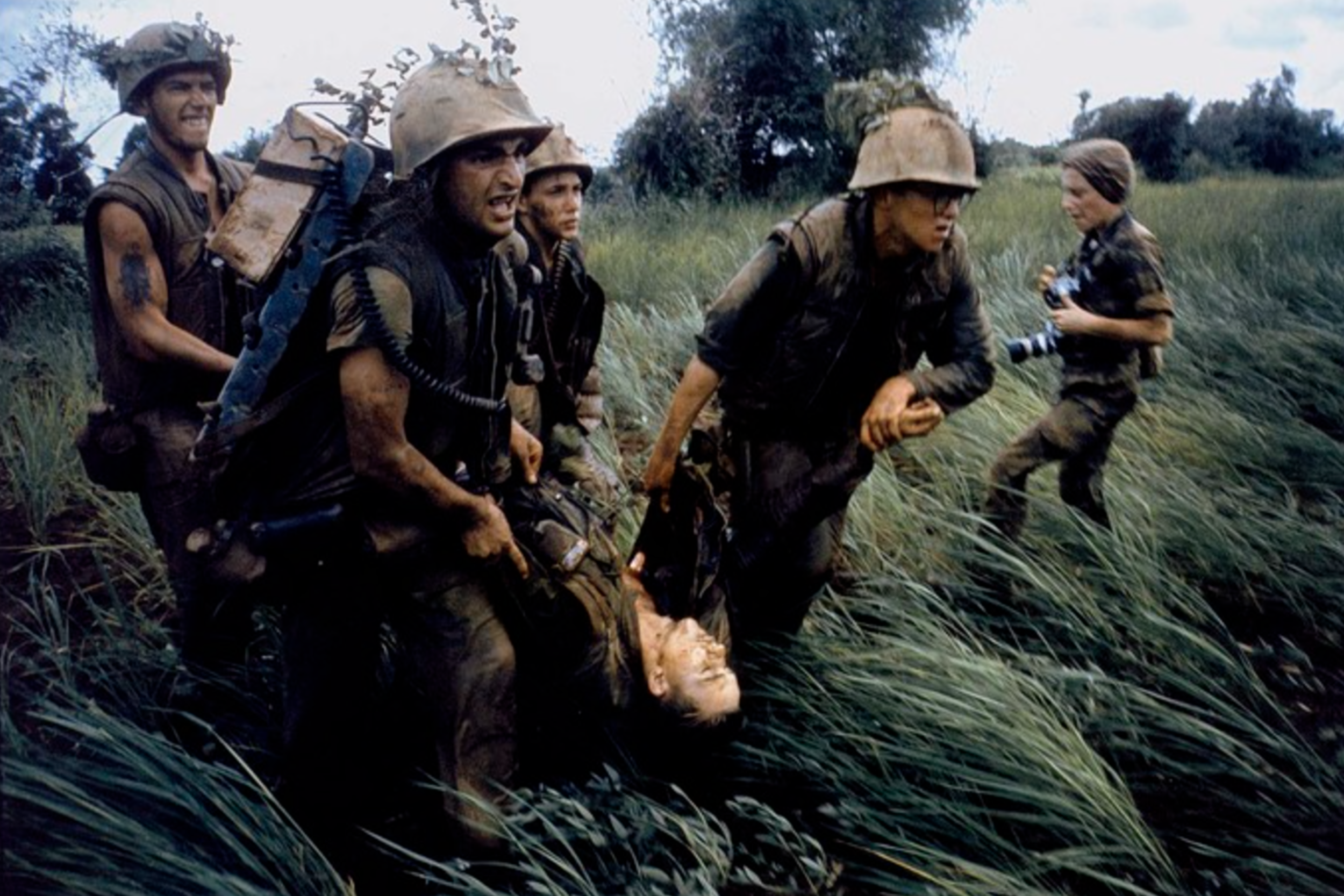
Vietnam, 1966, LIFE.